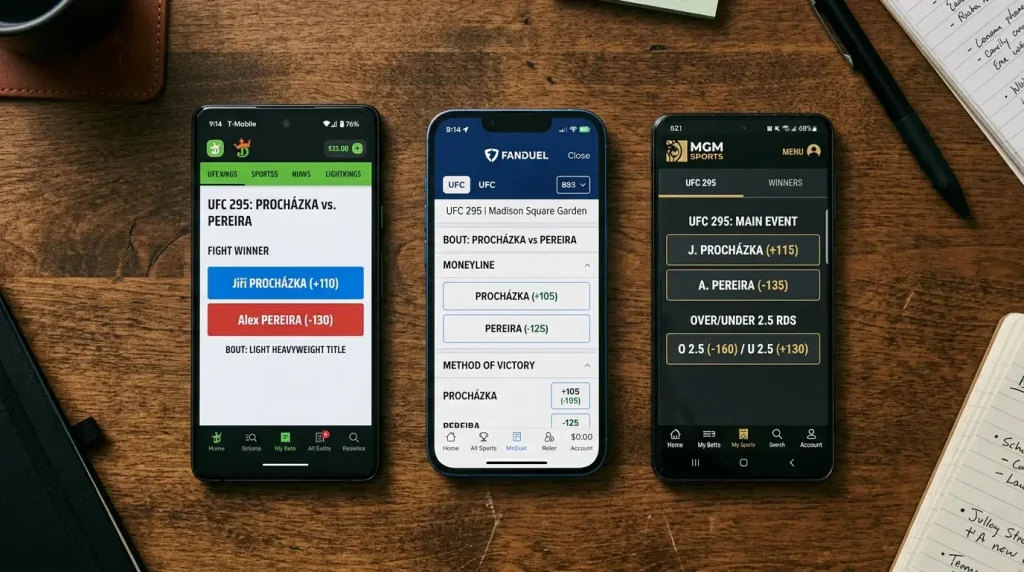
UFC Live Betting and Real-Time MMA Markets
 Available in US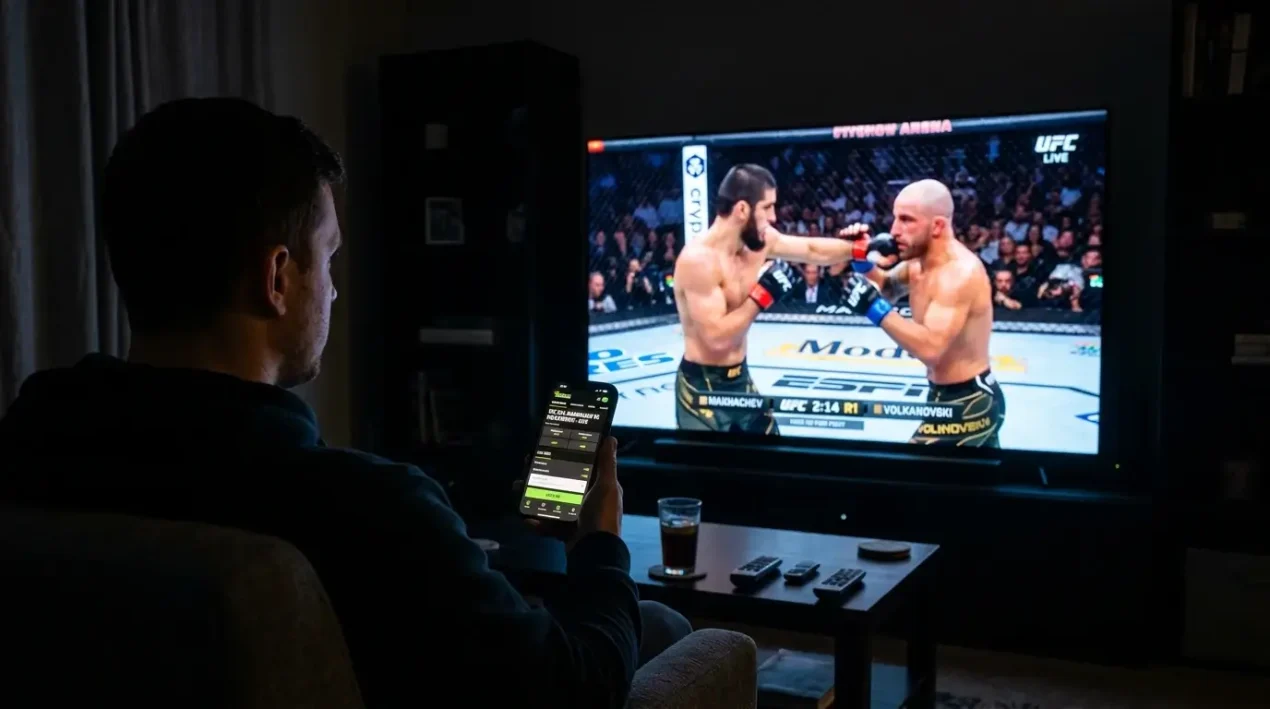
In-play UFC betting isn’t a faster version of pre-fight betting. It’s a different discipline entirely. Pre-fight analysis gives you days to build a profile, compare stats, and shop lines. Live betting gives you sixty seconds between rounds to process visual information, assess a fighter’s condition, and decide whether the new price reflects reality or overreaction. This guide covers the live markets available on UK platforms, the visual cues that predict momentum shifts, round-by-round entry triggers, and the cash-out decisions that separate disciplined live bettors from emotional ones.
To succeed in the in-play markets, you must be skilled at reading live odds movement patterns as the momentum shifts inside the octagon.
Live UFC Betting Markets: Real-Time Odds During the Fight
Walk into any UK sportsbook app during a UFC card and you’ll find four core live markets, though the depth varies significantly between platforms. Understanding what’s available — and what’s missing — determines which in-play strategies are actually executable for you.
The moneyline updates continuously during the fight. After every significant action — a knockdown, a takedown, a visible cut — the odds shift to reflect the new state of play. A fighter who was 4/7 pre-fight might drift to 6/4 after losing the first round, or tighten to 1/4 after landing a big shot. The moneyline is the broadest live market, available on every UK platform that offers in-play UFC betting.
Method of victory updates between rounds on most platforms, though some suspend this market during active fighting and only reopen it during the break. The logic is practical: a fighter who has been taken down three times in round one sees his “by decision” and “by submission” lines shift, while “by KO/TKO” may lengthen if the fight is clearly trending toward grappling. Between rounds, the bookmaker recalibrates based on what happened, and you have roughly sixty seconds to decide whether the new method price reflects your assessment.
Round totals — over/under — adjust after each round ends. If a five-round fight completes round one without incident, the over becomes slightly shorter because one round of potential finishing has passed without a finish. If round one features a knockdown and a near-stoppage, the under might shorten dramatically. This market rewards patience: waiting for one round of information before entering gives you data the pre-fight bettor didn’t have.
Next round winner is the most granular live market, and it’s not universally available. Some platforms offer it for main events only; others don’t offer it at all. When it’s available, it lets you bet on who wins the upcoming round based on what you’ve just watched. A wrestler who dominated round one with three takedowns is likely to attempt the same in round two — and the next-round price should reflect that dominance. If the platform hasn’t adjusted enough, you’ve found a live value play.
Speed of update is the variable that separates platforms for live UFC betting. Some sportsbooks refresh odds within two or three seconds of a significant action. Others lag by ten to fifteen seconds. That delay matters. If you see a knockdown on your television screen and your app hasn’t adjusted yet, the old price is temporarily mispriced. Some bettors exploit this latency deliberately, though platforms are getting faster at closing these windows.
Reading Momentum: Visual Cues Between Rounds
Between rounds, the cameras show you everything you need to make a live betting decision. The problem is that most people watch the corner advice and miss the body language. I’ve trained myself to ignore what the coaches are saying and focus entirely on the fighter’s physical state. Words lie. Bodies don’t.
Breathing is the first tell. A fighter sitting on the stool with controlled, measured breaths through the nose is managing his cardio. A fighter with his mouth open, chest heaving, shoulders rising with each inhalation is spending energy he may not have for the championship rounds. This distinction becomes critical in five-round fights, where the fourth and fifth rounds are where gas tanks separate contenders from pretenders. If your fighter’s breathing looks laboured after round two of a five-rounder, the over on total rounds shortens in your mental model, even if the bookmaker hasn’t adjusted the official line yet.
Swelling and cuts tell a different story. A fighter with a rapidly closing eye has a concrete disadvantage that compounds with each round. If the orbital swelling is severe enough, the ringside doctor may stop the fight — which settles method of victory markets as a TKO. A deep cut near the hairline bleeds dramatically but rarely causes stoppages. A cut on the eyelid is far more dangerous and far more likely to trigger a doctor’s intervention. Learning to distinguish between visually alarming but medically manageable cuts and genuinely fight-threatening damage is a skill that separates experienced live bettors from reactive ones.
Stance and movement upon returning to the centre of the octagon carry information too. A fighter who springs off the stool, bounces on his toes, and moves aggressively toward the centre is signalling confidence and energy. A fighter who rises slowly, walks flat-footed, and takes a defensive posture near the fence is conserving. Neither response guarantees the next round’s outcome, but they shift probabilities. The aggressive return suggests the fighter believes he can impose his will. The passive return suggests survival mode.
The finishing data adds context to these visual reads. With 45% of UFC fights ending by KO/TKO, the transition from competitive fight to finish often happens in the second or third round. That’s where accumulated damage from round one manifests as slower reactions and dropped hands. When you see a fighter absorbing shots he was slipping in round one, the live moneyline on his opponent is where the value concentrates — the market may not have adjusted to the visual deterioration you’re watching in real time.
One more cue that gets overlooked: the corner’s body language. Not their words — their posture. A cornerman leaning in with intensity, making eye contact, delivering crisp instructions is working with a fighter who’s still in the contest. A corner that’s leaning back, exchanging glances between themselves, or working urgently on a cut is managing a crisis. Their reaction often tells you more about the fighter’s condition than the fighter’s own behaviour, because corners see things the camera doesn’t always catch.
Round-by-Round Triggers: When to Enter and Exit
Not every round produces a betting opportunity. The mistake I made early on was treating every between-round break as a decision point. Most rounds end with both fighters in roughly the same competitive position they started in. The trigger for a live bet is a clear, material change in the fight’s trajectory — not a marginal shift in striking output.
A round-one knockdown is the most dramatic trigger. When a fighter gets dropped in the first round, the live odds on his opponent shift by 60-70% in most cases. That movement is usually justified — a knockdown indicates a power and timing advantage that’s likely to persist. But the size of the shift sometimes overcorrects. Favourites won 72% of UFC bouts in 2024, and a pre-fight favourite who gets dropped in round one is still the favourite for a reason — better skills, better preparation, better coaching. A fighter who gets dropped but recovers quickly, returns fire, and finishes the round on the front foot has demonstrated chin durability and composure. If the live moneyline on the dropped fighter has lengthened to 3/1 or 4/1, and your visual read says he’s recovered fully, that overcorrection is your entry point.
Takedown dominance in round one sets up a different trigger. A wrestler who completes three takedowns in round one has established a control pattern. His opponent hasn’t solved the puzzle yet. The over/under market should reflect this: if the wrestler is controlling but not finishing, the fight is trending toward a decision. Over 2.5 in a three-round fight or over 3.5 in a five-rounder becomes more likely with each round of wrestling control. The price on the over may not have adjusted enough, especially if the pre-fight expectation was a finish.
Women’s bantamweight provides the clearest statistical trigger in live betting. Fights in this division have gone past 1.5 rounds 96% of the time since 2020. If round one ends without a stoppage, the over on total rounds is nearly guaranteed based on historical data. The live price on over 1.5 after a completed first round should be extremely short — but it isn’t always. Some platforms lag in adjusting divisional-specific lines, and the gap between the statistical near-certainty and the offered price represents clean value.
Exit triggers are harder to define but equally important. If your live bet on a fighter is in profit and you’re watching his gas tank empty in round three, the question shifts from “will he win?” to “is the current cash-out offer better than my expected value of holding?” That calculation depends on how much his condition has deteriorated versus how many rounds remain. Two rounds left with a visibly fading fighter is a different risk profile than one round left. I’ll cover cash-out mechanics in detail next, but the principle applies here: your exit trigger should be a material change in condition, not a single moment of adversity.
Five-round main events create a unique trigger dynamic that three-round bouts don’t offer. The championship rounds — four and five — are where cardio separates elite fighters from good ones. A fighter who dominates rounds one and two but visibly slows in round three is giving you predictive information about rounds four and five. If the live moneyline on his opponent shortens after round three because the market has noticed the same fatigue pattern, the question is whether the adjustment is proportionate. Often it’s not: the market overcorrects toward the fresher fighter, creating value on the fading fighter if his lead on the scorecards is already comfortable enough to survive two close rounds.
Get real-time updates and expert tips from the leading UK mixed martial arts betting site.
Cash-Out Decisions: When to Lock In Profit, When to Hold
Cash-out exists because bookmakers make money from it. That isn’t a reason to avoid it — it’s a reason to understand when the price they’re offering you is fair and when it’s designed to save them money at your expense.
The mechanics are straightforward. If you’ve placed a live bet on Fighter A and he’s winning, the bookmaker offers you a cash-out amount that’s less than your potential full return but more than zero. You lock in profit now and give up the chance of a larger profit later. The bookmaker takes on the remaining risk, which they’re happy to do because the cash-out price includes their margin — you’re selling your position back to them at a discount.
When cash-out makes sense: your fighter has won the first two rounds convincingly but is showing signs of fatigue entering the third. His cardio history includes late-fight fades. His opponent is a known finisher in rounds three through five. The expected value of holding — accounting for the probability of a late stoppage — might be lower than the cash-out offer. In that scenario, taking the guaranteed profit is the disciplined play.
When cash-out is a trap: your fighter eats one clean shot in round two and the cash-out offer drops by 40%. You panic, take the reduced offer, and watch him recover to win comfortably. This is emotional cash-out — reacting to a moment rather than assessing the overall fight trajectory. One punch changes the odds but doesn’t necessarily change the outcome. The difference between a fighter who’s hurt and a fighter who’s in trouble is real, and only visual assessment can tell you which one you’re watching.
My rule is simple: I only consider cash-out if three conditions are met. First, my fighter’s physical condition has materially deteriorated since I placed the bet. Second, the remaining rounds carry a genuine finish risk based on the opponent’s skill set. Third, the cash-out offer represents at least 60% of the potential full return. If any of those conditions isn’t met, I hold. The temptation to lock in profit is powerful, but the maths of compounding small wins through disciplined holding outperforms habitual cash-out over the course of a year. For a deeper look at the strategy behind these decisions, including specific scenarios and expected value calculations, UFC cash-out strategy deserves its own analysis.
Five Live Betting Pitfalls and How to Avoid Them
I’ve committed every one of these errors, and a few of them more than once before the lesson stuck. Live betting amplifies the emotional side of gambling because the action is happening in front of you. Discipline isn’t just useful here — it’s the entire game.
Chasing losses mid-card is the most common pitfall. You lose your first live bet of the evening, and the next fight is starting. The temptation to double down and recover is overwhelming. The problem is that your second bet isn’t based on analysis — it’s based on the emotional need to get even. I’ve set a hard rule for myself: if I lose two consecutive live bets on the same card, I stop live betting for the rest of the evening. Pre-fight bets placed earlier in the week still stand, but no more in-play positions. This rule has saved my bankroll more often than any analytical edge.
Overreacting to a single punch is the visual version of chasing losses. A fighter lands one spectacular shot, the crowd erupts, and the live odds swing dramatically. But one punch isn’t a knockout. If the opponent absorbs it, stays standing, and continues fighting, the fight hasn’t changed as much as the odds suggest. Trained fighters absorb big shots regularly — it’s literally what they prepare for. The live bettor who backs the puncher at the new price after a single clean shot is paying a premium for excitement, not probability.
Ignoring latency is a technical pitfall. There’s a delay — sometimes two seconds, sometimes ten — between what happens in the octagon and when your sportsbook app reflects the new odds. If you’re placing bets based on what you see on screen, and the app is showing odds from five seconds ago, you might be getting a favourable price (the old odds on a fighter who just got hurt) or an unfavourable one (the old odds on a fighter who just landed a takedown). Know your platform’s lag. Test it during prelims before committing real money during the main card.
Betting every fight is the volume trap. A UFC card has ten to thirteen bouts. Feeling compelled to have a live bet on each one turns the evening into a marathon of impulsive decisions. The best live bettors I know — myself included, on good nights — place two or three in-play bets per card. That’s it. They wait for the trigger, assess the visual information, and only act when the price clearly misprices the situation. Everything else is entertainment viewing, not betting.
The fifth pitfall is abandoning pre-fight analysis once the fight starts. Dana White has spoken about how IC360 monitors betting activity on every UFC fight from the first prelim to the main event, and that level of surveillance exists because live markets attract both sharp and reckless money. Your pre-fight work — the fighter profile, the stylistic matchup, the statistical tendencies — doesn’t become obsolete when the bell rings. It becomes the framework for interpreting what you’re seeing. A wrestler who gets outstruck in round one hasn’t become a bad wrestler. He may be setting up a round-two takedown strategy. Your pre-fight model should inform your live decisions, not be overridden by sixty seconds of action.
How quickly do UFC in-play odds change during a fight?
UFC live odds can shift within two to ten seconds of a significant action, depending on the platform. Knockdowns, takedowns, and visible cuts trigger the fastest adjustments. Between rounds, odds update more gradually as the bookmaker recalibrates based on round scoring and fighter condition. Faster platforms offer tighter windows for exploiting mispriced lines.
Can I cash out a UFC live bet mid-round?
Most UK sportsbooks suspend cash-out during active fighting and only reopen the option between rounds. Some platforms offer continuous cash-out but at rapidly changing values that track the live odds. Check your bookmaker’s specific UFC cash-out policy, as availability varies between platforms and between market types.
What is the best moment to place a live UFC bet?
The between-round break offers the clearest window. You have roughly sixty seconds to assess visual cues — breathing, swelling, stance, corner behaviour — and compare the updated odds against your assessment. Round-one completion is a particularly strong entry point because it gives you real fight data that the pre-fight odds couldn’t account for, especially in divisions with strong statistical tendencies like women’s bantamweight.
This material was created by the OCTAPICKS team.
Related posts
UK UFC Audience Demographics and Betting Market Growth
UFC Betting Record Keeping and ROI Tracking