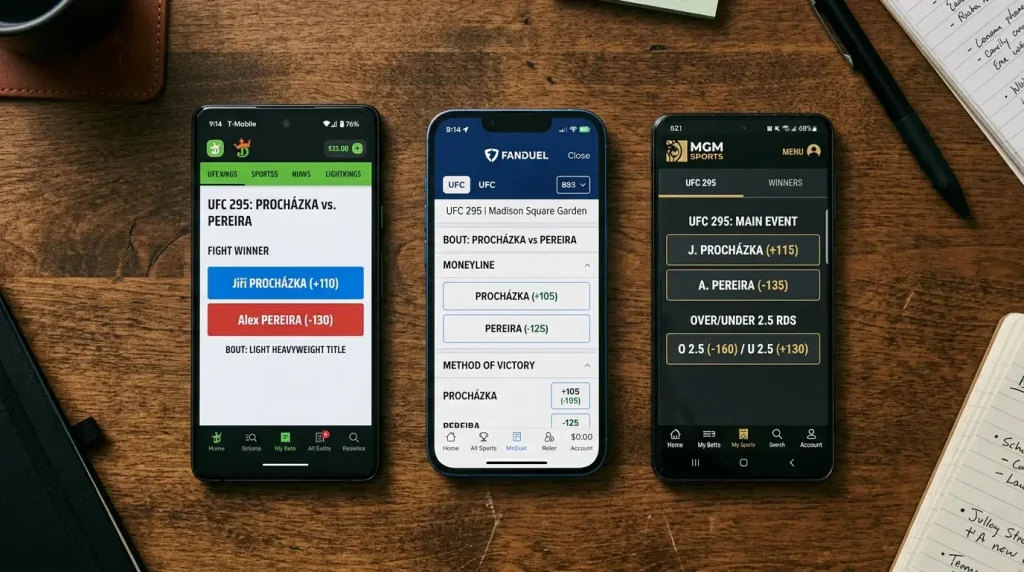
UFC Betting Odds Formats and Implied Probability
 Available in US
Here’s the uncomfortable truth that bookmakers rely on: most punters never move past the surface of odds. They see 4/7 and think “likely winner” without calculating what that price implies about the fighter’s real chances, or whether the bookmaker has built a healthy margin into that number. In 2024, favourites won 72% of UFC bouts. That sounds like a green light for backing the chalk every time — until you realise that the prices on those favourites rarely deliver profit at that win rate. The gap between implied probability and actual probability is where the money lives, and most bettors never look for it.
This guide strips the mystery from every odds format you’ll encounter as a UK punter. Fractional, decimal, American — each one is just a different way of expressing the same underlying information, and by the end you’ll convert between them without thinking. More importantly, you’ll understand implied probability: the hidden language inside every price that tells you exactly what a bookmaker believes about a fight. Once you can read that language, you stop guessing and start analysing.
Fractional UFC Odds: Calculating UK Sportsbook Payouts
The first time I tried to explain fractional odds to a mate, I used the phrase “the number on the right is your stake and the number on the left is your profit.” His eyes glazed over in about three seconds. So let me try what actually works: think of fractional odds as a ratio of profit to risk. That’s it. The left number is what you win, the right number is what you put up.
Take 4/7 — a common price on a UFC favourite. For every 7 you stake, you profit 4. Put down a 7 quid bet, you get 4 quid profit plus your 7 back, totalling 11. Scale that to a tenner: your profit is 10 multiplied by 4, then divided by 7, which gives you 5.71. Add your original 10 and the return is 15.71. The formula never changes: stake multiplied by the left number, divided by the right number, equals your profit.
Now look at the other side of that same fight. The underdog is priced at 5/2. For every 2 you stake, you profit 5. A tenner on this fighter returns 25 in profit plus your 10 stake — 35 total. The maths is identical, but the payout landscape shifts dramatically. This is why understanding the format matters: two fighters in the same bout, but the financial outcome of backing each one is wildly different.
Let me walk through a third scenario that trips up newer bettors. Imagine a closely matched fight priced at 10/11 for both fighters. This looks like a coin flip, and it nearly is — but not quite. Your tenner on either side returns 9.09 profit. The bookmaker has shaded both prices just below evens (1/1), which is where their margin hides. At true evens you’d profit 10 on a 10 stake; at 10/11 you profit slightly less. That difference, accumulated across thousands of bets from thousands of punters, is how the sportsbook pays the bills.
Where fractional odds get awkward is with complex fractions. You’ll occasionally see lines like 8/13 or 11/8 on UFC fights, and the mental arithmetic becomes harder. I’ve been doing this for six years and I still pause on 8/13. Quick conversion: 8 divided by 13 is roughly 0.615, so a tenner returns about 6.15 profit. Not elegant, but accurate. This is the main reason many UK bookmakers now let you toggle to decimal format — the underlying maths is the same, but the presentation is cleaner when the fractions get ugly.
One thing worth noting: fractional odds are the historical default across British sportsbooks. Horse racing, football, boxing — the format has been standard for decades. When UFC markets first appeared on UK platforms, they inherited the same presentation. Some newer punters who came to betting through American MMA coverage find fractional confusing because they learned odds as plus-minus numbers. If that’s you, don’t worry — we’ll cover American format shortly, and the conversion is straightforward.
Decimal Odds: The Simpler Alternative
I switched to decimal odds about three years into my betting career, and my accuracy on quick mental calculations jumped almost immediately. Not because I got smarter — decimal format just does most of the work for you. The number you see is your total return per pound staked. That’s it. No dividing, no separating profit from stake. Multiply and you’re done.
Let’s revisit those same three fights from the fractional section. The 4/7 favourite? In decimal, that’s 1.57. A tenner returns 15.70 total. The 5/2 underdog becomes 3.50 — a tenner returns 35.00. The 10/11 near-coin-flip converts to 1.91 — a tenner returns 19.10. Notice how much faster your brain processes 1.57 compared to 4/7. There’s no numerator-denominator dance. The price is the multiplier.
Converting between the two formats is simple arithmetic. To go from fractional to decimal: divide the left number by the right number, then add 1. So 4/7 becomes 4 divided by 7 (0.571) plus 1, giving you 1.571. To reverse it — decimal back to fractional — subtract 1 from the decimal, then express the result as a fraction. 3.50 minus 1 equals 2.50, which is 5/2. Clean conversions like this don’t always happen, though. A decimal price of 1.615 converts to roughly 8/13, which is why the decimal format exists in the first place.
Where decimal really earns its keep is accumulator betting. If you’re combining three UFC moneyline picks into one acca, you multiply the decimal odds together. Fighter A at 1.57, Fighter B at 2.10, Fighter C at 1.35 — the combined decimal is 1.57 times 2.10 times 3.297, which equals 4.45. A fiver on that acca returns 22.25 if all three win. Try doing that multiplication with 4/7, 11/10 and 7/20 in fractional format, and you’ll understand why decimal is the go-to for multi-leg bets.
Most UK sportsbooks offer a toggle between fractional and decimal in your account settings. Some default to fractional but switch automatically for accumulators. My recommendation: set your default to decimal if you’re serious about comparing prices across bookmakers. When you’re scanning three or four platforms for the best line on a fight, comparing 1.57 against 1.62 is instant. Comparing 4/7 against 8/13 takes longer and invites errors. The underlying value is the same — it’s the presentation that slows you down or speeds you up.
American Odds: What They Mean When You See Them
You won’t use American odds on a UK sportsbook. So why am I covering them? Because the moment you open an MMA podcast, browse an American fight preview, or scroll through social media before a card, you’ll see lines written as -180 or +220. Without context, those numbers look like temperature readings. With context, they’re just another expression of the same probability.
American odds revolve around a baseline of 100. A negative number tells you how much you need to stake to win 100 units of profit. A -180 favourite means you stake 180 to profit 100 — or proportionally, an 18-pound bet profits 10. A positive number tells you how much you profit on a 100-unit stake. A +220 underdog means a 100-pound stake returns 220 profit — or proportionally, a tenner returns 22.
Converting to decimal: for negative American odds, divide 100 by the absolute value and add 1. So -180 becomes 100 divided by 180 (0.556) plus 1, equalling 1.556. For positive American odds, divide the number by 100 and add 1. +220 becomes 2.20 plus 1, equalling 3.20. From there you can go to fractional using the method in the previous section.
The practical takeaway: you don’t need to bet in American format. You need to read it well enough to follow the conversation. When an analyst says “this fighter opened at -250 and has drifted to -180,” you should instantly understand that the market’s confidence in that fighter has dropped. The favourite has become less favoured. In UK fractional terms, that’s roughly a shift from 2/5 to 5/9 — more generous odds, more implied doubt. Recognising that shift matters far more than memorising conversion formulas, because odds movement carries information about where the sharp money is flowing.
Implied Probability: What the Odds Actually Tell You
A few years back, I had a conversation with a fellow analyst who said something that rewired how I approach every single fight: “Odds aren’t predictions — they’re prices.” That distinction sounds academic, but it changes everything. A bookmaker isn’t telling you a fighter will win. They’re telling you what they’ll charge you for the chance that he might. Implied probability is the tool that translates that price into a percentage you can actually work with.
The formula for fractional odds: divide the right number by the sum of both numbers, then multiply by 100. For a 4/7 favourite, that’s 7 divided by (4 + 7), times 100 — giving you 63.6%. The bookmaker’s price implies this fighter has a 63.6% chance of winning. For the 5/2 underdog on the other side: 2 divided by (5 + 2), times 100 — which is 28.6%. For decimal: divide 1 by the decimal price. So 1.57 gives you 1 divided by 1.57, equalling 63.7%. Rounding differences aside, both formats produce the same implied probability.
Here’s where it gets interesting. Add up both fighters’ implied probabilities from the 4/7 and 5/2 example: 63.6% plus 28.6% equals 92.2%. That’s below 100%, which in a real market would be unusual — it would mean the bookmaker has no built-in margin and is actually giving you an edge. In practice, you’ll almost never see this. The example uses round hypothetical numbers; real bookmaker prices are calibrated so the combined probability exceeds 100%.
In reality, bookmaker prices produce a combined implied probability that exceeds 100%. If the favourite is priced at 4/7 (63.6%) and the underdog at 6/4 (40%), the total is 103.6%. That extra 3.6% is the overround — also called the vig or juice. It’s the bookmaker’s built-in margin. Every price you see has this margin baked in, which means implied probability from raw odds always overstates both fighters’ chances. To find the “true” implied probability, you need to remove the overround by dividing each fighter’s raw probability by the total. In this case, the favourite’s adjusted probability is 63.6 divided by 103.6, equalling 61.4%. That 2.2% difference is the tax you’re paying to place the bet.
Why does this matter practically? Because your job as a bettor is to find fights where your own probability estimate exceeds the adjusted implied probability. If the bookmaker’s adjusted price implies a fighter has a 61% chance, and your analysis gives her 70%, you have a value bet. Favourites won 72% of UFC bouts in 2024, but the average implied probability priced into favourites was higher than 72% — meaning the bookmaker charged more than the win rate justified. Blindly backing favourites is a slow bleed. Selectively backing favourites whose true probability exceeds the adjusted implied probability is a strategy.
One more data point that illustrates the value gap: underdogs priced at +200 or longer won 39% of their fights in 2024. The implied probability at +200 is roughly 33%. That 6% gap between implied and actual win rate represents real, measurable value that the market left on the table for anyone paying attention.
When the Odds Get It Wrong: Finding Value in UFC Lines
Last year, I tracked every main event where the closing line didn’t match my pre-fight model, and the results shook a few assumptions I’d been carrying. The biggest surprise wasn’t that underdogs won more than expected — it was that certain categories of underdogs won consistently enough to constitute a genuine market inefficiency.
Value betting in UFC isn’t about picking winners. It’s about finding prices that understate a fighter’s actual chances. If you flip a coin and someone offers you 3/1 on heads, you take that bet every time — not because you know heads will land, but because the price exceeds the probability. UFC markets work identically, except the “coin” has stats, a training camp, a weight cut, and a style matchup attached to it.
The champion-underdog phenomenon is one of the cleanest examples of persistent value in UFC betting. When a reigning champion enters a fight as the betting underdog — which happens more often than you’d think in divisions with dominant contenders — they’ve defended their title 63% of the time. The market prices them as underdogs, implying sub-50% win probability, but they win nearly two-thirds of those fights. That’s a structural gap between price and reality, and it’s been consistent across multiple years of data.
Finding value requires two separate skills. First, you need an honest probability estimate. This means looking at fighter stats — significant strikes landed per minute, takedown defence percentage, finishing rate — and building a profile for each combatant. Second, you need to compare your estimate against the bookmaker’s implied probability after removing the overround. The gap between those two numbers is your edge, or lack of one. No gap, no bet. Negative gap, definitely no bet.
David Ellison, the chairman of Paramount, called the UFC “a unicorn asset that comes up about once a decade.” He was talking about media rights, but the phrase applies equally to the betting market. UFC is still young enough, and niche enough, that the odds-setting machinery doesn’t have the same depth of data as football or tennis. Bookmakers rely on smaller sample sizes, shorter fighter histories, and fewer statistical models. That creates more opportunities for a prepared bettor to find mispriced lines — but only if you’re doing the analytical work that most punters skip. If you’re ready to go deeper into how different types of UFC bets interact with these value concepts, that’s where the strategy starts getting genuinely interesting.
Five Odds-Reading Mistakes UK Punters Make
I’ve made every one of these mistakes, some of them more than once. The embarrassing part isn’t the losses — it’s how long I continued making them before someone pointed out what I was doing wrong. Save yourself the tuition fees.
The first mistake is ignoring the overround entirely. You see a favourite at 4/9 and an underdog at 2/1, calculate implied probabilities of 69.2% and 33.3%, and think the bookmaker expects the favourite to win about 69% of the time. But those probabilities sum to 102.5%. The bookmaker’s actual view of the favourite is closer to 67.5% after accounting for their margin. Ignoring the overround means you’re working with inflated probability estimates for every fighter on every card. Over hundreds of bets, that distortion eats your bankroll from the inside.
The second mistake is confusing formats mid-calculation. I’ve watched punters mentally process a decimal price as though it were fractional. A fighter priced at 2.50 in decimal returns 25 on a tenner total. But if you accidentally treat 2.50 as fractional — meaning 5/2 — you’d calculate the same way: 10 times 5 divided by 2 equals 25 profit, plus your stake makes 35. Coincidentally, 5/2 and 2.50 produce different payouts (35 vs 25 total), and mixing them up mid-bet is how punters end up confused about whether they won or lost money.
The third mistake is backing heavy favourites without checking value. A fighter priced at 1/5 (decimal 1.20) needs to win 83% of the time just to break even. Very few UFC fighters in any division maintain an 83% win rate over a meaningful sample. When you bet at 1/5, you’re paying a premium for perceived certainty — and UFC has a way of punishing certainty. One upset erases the profit from four winning bets at that price.
The fourth is comparing prices across formats without converting. “This bookmaker has him at 6/4 and that one has him at 2.60 — which is better?” You can’t answer that question without converting both to the same format. 6/4 in decimal is 2.50. So 2.60 is better. It takes five seconds to convert, but skipping that step means you might leave value on the table or, worse, take the worse price thinking it’s the better one.
The fifth mistake — and this one took me the longest to fix — is ignoring line movement. Odds aren’t static. They open at one price and shift based on betting volume, injury news, weigh-in results, and sharp money. A fighter who opens at 5/4 and moves to evens has attracted significant backing. That movement carries information: either the public is piling on, or informed bettors have spotted something. Treating opening odds as gospel and ignoring how they’ve moved by fight night is like checking the weather forecast on Monday and dressing for it on Friday.
How do I calculate my return from 4/7 fractional odds?
Multiply your stake by 4, then divide by 7. A 10 bet at 4/7 returns 5.71 profit plus your original 10 stake, giving a total return of 15.71. The left number always represents profit and the right number represents the stake required to earn that profit.
How do I convert fractional UFC odds to decimal?
Divide the left number by the right number and add 1. For example, 5/2 becomes 5 divided by 2 (2.50) plus 1, equalling 3.50. To reverse it, subtract 1 from the decimal price and express the result as a fraction. Decimal 3.50 minus 1 equals 2.50, which is 5/2.
Why do different bookmakers show different UFC odds for the same fight?
Each bookmaker sets their own overround (built-in margin) and adjusts prices based on their exposure — how much money they’ve taken on each side. Sharp bettors placing large wagers can move one bookmaker’s line while another’s stays unchanged. Market differences are normal and create opportunities for line shopping.
What is overround and how does it affect my UFC bets?
Overround is the bookmaker’s margin, visible when you add up the implied probabilities of all outcomes and get a total above 100%. A 3% overround means the bookmaker takes roughly 3% from every pound wagered. Lower overround means better value for the bettor. Comparing overround across platforms helps you find the most competitive UFC prices.
This material was created by the OCTAPICKS team.
Related posts

UK UFC Audience Demographics and Betting Market Growth

UFC Betting Record Keeping and ROI Tracking