
UFC Odds Movement Patterns and Line Shifts
 Available in US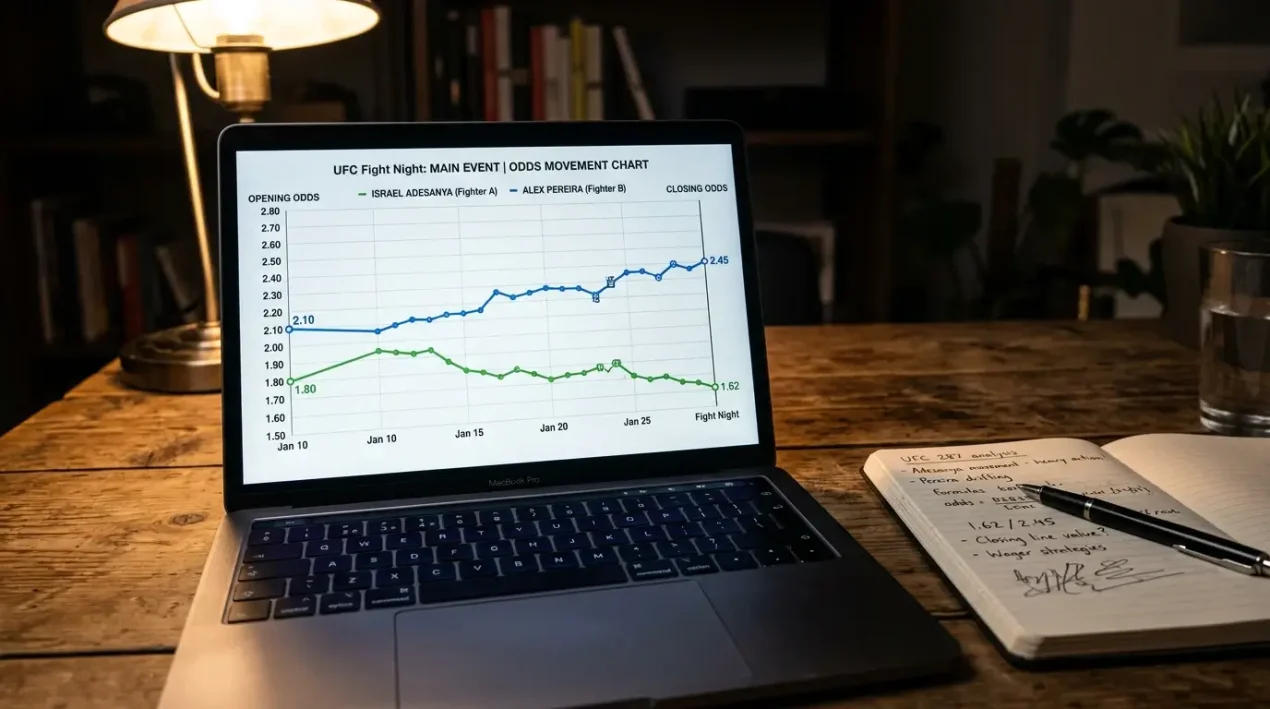
In 23% of UFC main events, the underdog transitions into the favourite within the final 48 hours before the fight. That is not a marginal number. Nearly one in four headliners sees a complete reversal of the market’s assessment. If you are placing bets without tracking where the line opened and where it is headed, you are betting blind.
Pre-Game Line Shifts: Tracking Volume, News, and Sharp Action
Three forces move UFC lines, and they operate on different timescales. Public money is the slowest. As a fight card approaches, casual bettors pile onto names they recognise – the champion, the knockout artist, the fighter who went viral on social media. This money shifts lines gradually, usually toward the favourite, and it tends to arrive between Wednesday and Saturday of fight week. If you see a favourite’s price shortening steadily over several days without any news catalyst, that is public money at work.
News-driven shifts are faster and more abrupt. An injury report, a failed weight cut, a coaching change announced on social media, even a questionable sparring clip – any of these can move a line within hours. These shifts are legitimate and reflect new information entering the market. The key for bettors is timing: if you receive the news before the line moves, you have a window. If the line has already moved, the value has already been priced in. Social media has compressed this window dramatically. What used to take a day to filter through the MMA community now hits the market in minutes.
Sharp money is the fastest and least visible force. Professional bettors and syndicates place large wagers that bookmakers identify and respond to immediately. A sharp bet does not just move the line at the book where it was placed – it cascades across the market as other bookmakers adjust to avoid exposure. You will rarely see sharp money arrive; what you see is the aftermath, a sudden line correction that has no obvious public explanation. In 23% of main events, that sharp action is strong enough to flip the line entirely.
Understanding which force is driving a given shift is the difference between following the market intelligently and being dragged along by it. Public money creates opportunities for sharps. News creates opportunities for anyone paying attention. Sharp money creates traps for anyone who arrives late.
How to Interpret Line Movement for Your Bets
A steam move is the sharpest type of line shift – a rapid, significant correction that occurs when multiple sharp bettors hit the same side simultaneously. In UFC, steam moves typically happen in the 24 to 48 hours before a fight and are characterised by a line that jumps 20 or more points in a short window. If a fighter goes from -160 to -200 in under an hour, that is a steam move. It tells you that informed money – money with an edge – has landed decisively on one side. Fighting a steam move is rarely profitable. These are people who do this for a living, and when they move together, they tend to be right.
Organic drift is the opposite: a slow, steady movement driven by accumulated public and recreational bets. A line that moves from -150 to -170 over five days is drifting, not steaming. Organic drift is less informative because it reflects volume rather than insight. The favourite is attracting more money simply because they are the favourite, not because new information has emerged. Organic drift toward a favourite can actually create value on the underdog, since the public is compressing the favourite’s price without any analytical basis.
Reverse line movement is the most confusing pattern and the one I get asked about most. It occurs when the line moves in the opposite direction from where the majority of bets are landing. If 75% of bets are on Fighter A, but the line moves toward Fighter B, it means the smaller number of bets on Fighter B carry more total weight – in other words, sharp money is on Fighter B while the public backs Fighter A. Reverse line movement is one of the strongest signals in sports betting, and in UFC it appears more frequently than in higher-volume sports because the market is thinner and sharp action has a proportionally larger impact.
Normal Drift vs Suspicious Shifts
There is a line between sharp action and suspicious action, and it is not always easy to draw. Normal line movement, even aggressive movement, has identifiable characteristics: it correlates with known information (injury reports, weigh-in results, camp news), it occurs within a plausible range (20-40 points for a significant development), and it stabilises once the information is absorbed.
The Dulgarian case from November 2025 showed what falls outside those boundaries. A shift from -250 to -130 – a 120-point collapse – with no public news to justify it tripped every alarm in the system. That kind of movement does not happen because a sharp bettor had a good model. It happens when the market receives information that the public does not have and should not have. IC360 flagged it, three bookmakers voided bets, and the incident became the most discussed integrity case in recent UFC history.
For practical purposes, I apply a simple rule: if a line moves more than 50 points without any corresponding news, I do not bet the fight. Not on either side. A clean market has transparent drivers for its movements. A market that moves in a vacuum is a market I cannot read, and a market I cannot read is one where I have no edge. Passing on a fight feels like a missed opportunity until you remember that protecting your bankroll from unreadable situations is itself a profitable strategy over time.
Timing Your Entry Around the Shift
Line movement creates value for bettors who understand timing. The best prices on favourites typically appear at the opening line, before public money compresses them. The best prices on underdogs often emerge late, after public money has pushed the favourite lower and inflated the underdog’s return. If your analysis favours the favourite, bet early. If it favours the underdog, patience usually pays.
That is the framework. The execution requires discipline – particularly the discipline to watch a line move against you and trust that your opening position was the correct one. It also requires access to tools that track live odds across multiple platforms. Oddschecker provides this for UK-licensed bookmakers, and it is the first tab I open when I start analysing a UFC card. The opening line, the current line, and the direction of movement between them are three data points that every bettor has access to and far too few bother to use.
Where can I track UFC odds movement in real time?
Oddschecker is the most widely used odds comparison tool for UK punters and tracks UFC odds across major UKGC-licensed bookmakers in real time. BestFightOdds is another popular option that focuses specifically on MMA and provides historical line data, opening prices, and movement charts for every scheduled UFC bout.
How far before a UFC fight do odds typically stabilise?
UFC odds usually stabilise within 2-4 hours of the scheduled start time, though late-breaking news – a failed weight cut, a last-minute injury – can cause movement right up until the cage door closes. The biggest shifts occur in two windows: immediately after the fight is announced (when sharp money enters) and in the final 48 hours before the event (when weigh-in results and late information hit the market).
This material was created by the OCTAPICKS team.
Related posts

UK UFC Audience Demographics and Betting Market Growth
UFC Betting Record Keeping and ROI Tracking