UFC Cash-Out Strategy and In-Play Profit Logic
 Available in US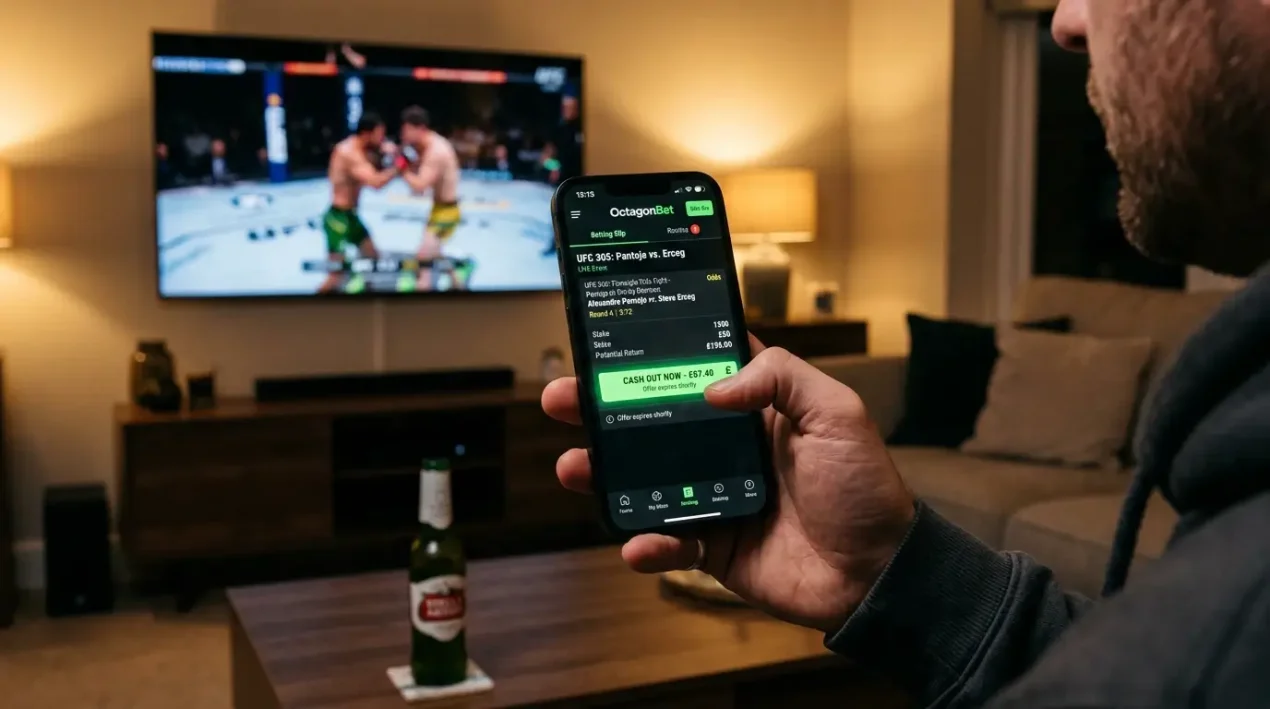
UFC fights end by knockout or TKO 45% of the time, and any of those finishes can arrive without warning. A fighter can dominate two rounds and get clipped by a single shot in the third. That volatility makes cash-out decisions in MMA fundamentally different from football or tennis, where momentum shifts are slower and reversals are rarer. In live UFC betting, the cash-out button is not just a convenience feature – it is a risk management tool, and knowing when to press it is a skill in itself.
UFC Cash-Out Mechanics and Live Betting Adjustments
Before we talk strategy, let me clear up the mechanics because I have seen enough confusion on forums to know it is needed. When you place a bet and the situation moves in your favour, your bookmaker offers you a cash-out amount. This amount is always less than your potential full payout – the difference is the bookmaker’s margin on the feature. Think of it as an insurance premium: you are paying the bookmaker to take over your risk.
Full cash-out closes your bet entirely. You receive the offered amount regardless of what happens next. If your fighter goes on to win, you miss the full payout but keep the guaranteed profit. If they lose, you have already banked something rather than nothing. The maths behind the offer is straightforward: the bookmaker recalculates the implied probability of your remaining outcome based on live conditions and applies their margin. A -200 favourite with two rounds to go might have a 70% implied chance of winning; the bookmaker offers you a cash-out that reflects roughly a 60-65% probability, keeping 5-10% for themselves.
Partial cash-out is available on most major UK platforms and allows you to lock in a portion of your profit while keeping the rest of your bet active. If the cash-out offer is GBP 80 on a bet that would pay GBP 120, you could cash out GBP 40 and let the other half ride. This is the feature I use most frequently because it lets me hedge without abandoning my position entirely. The key limitation is that not all platforms offer partial cash-out on UFC markets specifically – some restrict it to pre-match or to certain bet types.
Three Scenarios Where Cashing Out Makes Sense
The first scenario is the one I described in the intro: your fighter is fading. You backed a wrestler who controlled round one with takedowns but is now breathing heavily, standing more, and eating shots. The scorecards probably favour your pick, but the trajectory does not. Cashing out here is not cowardice – it is reading the fight correctly and acting on what you see. A fighter who fades in the middle rounds rarely recovers in the third unless they are a championship-calibre athlete with proven deep-water cardio.
The second scenario involves visible injury. UFC generates 11% of all live betting clicks on fight nights, which means the bookmakers are adjusting their cash-out offers in near real time. If your fighter takes a shot that opens a cut above their eye or starts limping after a leg kick, the cash-out offer will drop quickly – but not as quickly as the actual probability of them winning. There is a brief window where the offer still reflects pre-injury conditions while the fight itself has shifted. Hitting cash-out in that window is one of the rare situations where the feature works clearly in your favour.
The third scenario is the coin-flip leg in an accumulator. If your acca has one leg remaining and it is a genuine 50-50 fight, the expected value of holding is roughly equal to the cash-out offer minus the bookmaker’s margin. In other words, you are paying the margin for certainty. Whether that trade is worth it depends entirely on your bankroll situation. If the cash-out amount is meaningful relative to your bankroll and the remaining fight is unpredictable, take the money. The marginal EV you sacrifice is trivial compared to the certainty you gain.
When Holding Is the Better Play
Not every cash-out opportunity is worth taking, and this is where too many bettors go wrong. The emotional pull of locking in profit is strong, especially during a fight – your pulse is elevated, the crowd is screaming, and your phone is flashing a number you could have right now. Making sound EV decisions in that state is almost impossible unless you have a framework in place before the fight starts.
The framework is simple. Calculate the implied probability of your remaining outcome. If your own assessed probability is higher than the implied probability baked into the cash-out offer, hold. If a bookmaker is offering you cash-out on a -300 favourite (implied 75%), and your analysis of the fight so far suggests an 85% win probability, the cash-out is underpriced. Holding delivers better expected value over time, even if any single fight can go sideways.
I hold when three conditions are met: my fighter is winning clearly on the scorecards, they show no signs of physical deterioration, and their opponent has not demonstrated the ability to finish the fight with a single strike. If all three are true, the cash-out is selling my position below its real value, and I would rather ride the probability than hand margin to the bookmaker.
The trap to avoid is emotional cash-out – hitting the button because your fighter took one hard shot and you panicked. One punch does not change the statistical trajectory of a fight. If your fighter absorbed a clean right hand in round two but is still moving well, still controlling range, and still winning the round on volume, the cash-out impulse is fear talking, not analysis. I keep a rule for myself: no cash-out decisions during active exchanges. I only look at the offer between rounds, when I can assess my fighter’s condition calmly.
The Button Is a Tool, Not a Reflex
Cash-out in UFC betting is a risk transfer mechanism. You are paying the bookmaker’s margin to convert uncertainty into a guaranteed outcome. Sometimes that trade makes sense – when the fight is shifting, when an injury appears, when the last leg of your acca is a genuine toss-up. Other times it destroys value – when you are winning clearly, when the remaining probability is high, or when your fear of losing overrides your analysis. The discipline is in knowing which situation you are in before the button starts flashing. Set your thresholds cold, before the first walkout. That is the only way cash-out becomes a strategy rather than a panic response.
Do all UK bookmakers offer cash-out on UFC bets?
Most major UKGC-licensed bookmakers offer cash-out on UFC moneyline and accumulator bets, including bet365, Paddy Power, and William Hill. However, availability can vary by market type – some platforms do not support cash-out on method of victory or round betting markets. Partial cash-out is less universally available. Check your specific platform’s terms before assuming the feature will be there when you need it.
Can I partially cash out a UFC accumulator?
Yes, several UK bookmakers support partial cash-out on UFC accumulators. This allows you to lock in a portion of your profit while keeping part of the bet active for the remaining leg or legs. The proportion you can cash out varies by platform. Partial cash-out is particularly useful when you want to guarantee some return from a multi-leg acca without completely surrendering the potential full payout.
This material was created by the OCTAPICKS team.
Related posts
UK UFC Audience Demographics and Betting Market Growth
UFC Betting Record Keeping and ROI Tracking