
UFC Betting Odds and MMA Markets 2026
 Available in US
I placed my first UFC bet in 2020 — a tenner on a heavy underdog in a prelim card fight that nobody was talking about. I'd spent the week digging through striking differentials and takedown defence rates while the rest of the betting public was busy backing the name they recognised from a highlight reel. That underdog won by second-round submission, and the payout itself wasn't life-changing, but the process was. It taught me that UFC betting odds aren't random numbers slapped onto a screen — they're compressed opinions, and opinions can be wrong.
Six years on, I'm still finding edges in those opinions, and the market has exploded around me. Global MMA betting handle hit $10.3 billion in 2024, a 17% year-on-year surge that turned mixed martial arts from a niche wager into one of the fastest-growing verticals in sports betting. UFC drives the overwhelming majority of that volume, and the UK is one of its most active markets. Yet walk into any high-street bookmaker or scroll through the average operator's MMA page, and what do you find? A list of odds with zero context. No finish-rate breakdowns, no line-movement data, no explanation of why a -250 favourite might actually be terrible value.
That gap is exactly why this guide exists. Favourites win roughly 72% of UFC bouts — a stat that none of the major UK betting sites bother to publish, let alone contextualise. Knowing that number changes how you read a price sheet. Knowing that underdogs at +200 or longer won 39% of their fights last year changes it even more. And when you factor in a global fan base of 700 million people driving liquidity into these markets, you start to understand why UFC odds move the way they do and where the value hides.
$10.3B
Global MMA betting handle in 2024 — up 17% year on year
72%
Favourite win rate across all UFC bouts in 2024
700M
Estimated worldwide UFC fan base
This guide covers everything from reading fractional odds on your UK sportsbook to spotting suspicious line shifts hours before a weigh-in. I've structured it so you can start from scratch or skip to the sections that sharpen what you already know. Along the way, I'll share the data points, the divisional patterns and the analytical habits that have shaped how I approach every single UFC card. No operator rankings, no affiliate pitches — just the information you need to read, analyse and beat the lines.
Sharp UFC Bettor Habits: Utilizing Data for Profitable Returns
- UFC odds in the UK default to fractional format, but switching to decimal simplifies accumulators and implied probability calculations — learn both and use the one that suits the bet type.
- Favourites won 72% of UFC bouts in 2024, yet underdogs at +200 or longer took 39% of theirs — value lives in the gap between perception and data.
- Divisional patterns are free information: heavyweight bouts finish by KO 62% of the time, while 96% of women's bantamweight fights go past 1.5 rounds.
- Flat staking at 2% of your bankroll per bet absorbs the variance that UFC's high-finish-rate format creates — discipline protects capital more than any single pick.
- Every UFC platform you use must hold a UKGC licence. The UK remote gambling sector generated £7.8 billion in gross gambling yield last year, and that regulatory framework exists to protect your funds.
UFC Betting in 2026: Market Size, Media Deals and What They Mean for Your Bets
Two years ago, if you'd told me that UFC media rights would be worth more per year than the Champions League's domestic UK deal, I'd have raised an eyebrow. Then Paramount wrote a cheque for $7.7 billion over seven years — averaging $1.1 billion annually — and the eyebrow stayed up. That deal didn't just validate UFC as premium sports content. It fundamentally reshaped the betting landscape for everyone holding a sportsbook account in the UK.
Let me walk you through why the money matters to you as a punter.
$10.3 billion — the total amount wagered on MMA globally in 2024, a 17% increase from the previous year. UFC accounts for the vast majority of that handle.
The global sports betting market sits at roughly $108.9 billion, and MMA's share makes it one of the fastest-growing segments in the industry. UFC's own market valuation has climbed to an estimated $1.74 billion in 2026, with projections pushing it toward $2.79 billion by 2033 at an 8% compound annual growth rate. Those aren't abstract financial figures — they translate directly into deeper markets, tighter spreads and more prop options on your sportsbook screen every fight night.
The Paramount/CBS Deal and the Death of Pay-Per-View
UFC's $7.7 billion agreement with Paramount means all 43 annual UFC events are now available on Paramount+ without additional pay-per-view charges. Mark Shapiro, President and COO of TKO Group Holdings, put it bluntly: the pay-per-view model belongs to the past. For bettors, the shift is significant — free access to every card means more casual viewers tuning in, more betting accounts activated on fight nights, and ultimately deeper liquidity across UFC markets.
The ripple effects of that media deal are already visible. UFC's debut on CBS in March 2026 — UFC 326 — pulled in 2.47 million viewers, the promotion's largest linear television audience in a decade. David Ellison, Paramount's Chairman and CEO, called UFC "a unicorn asset that comes up about once a decade," and the viewership numbers back him up. The organisation broadcasts into more than 950 million households across 210 countries in 50 languages, and its social media footprint exceeds 300 million followers.
$1.74B
UFC's estimated global market value in 2026
950M+
Households receiving UFC broadcasts worldwide
300M+
UFC social media followers across all platforms

What does all of this mean for your bets? More eyeballs create more bettors, more bettors create more liquidity, and more liquidity creates sharper, more competitive odds. Three years ago, prop markets for prelim-card bouts were often thin and slow to update. Now, even the early prelims carry method-of-victory and round-betting markets with meaningful depth. The explosion in UFC's media presence hasn't just grown the sport — it's grown the quality of the markets you're betting into.
Understanding the market's scale sets the stage, but none of it helps unless you can read the prices in front of you. Let's break down how UFC odds actually work.
How UFC Odds Work: Fractional, Decimal and American Formats
I once watched a mate stare at his phone for a solid minute trying to work out what 8/13 meant on a UFC main event. He knew the fighter he wanted to back. He had no idea what he'd actually win. That moment crystallised something for me: odds formats aren't just notation — they're the language of the market, and if you can't read the language, you're betting blind.
Three formats dominate UFC betting. If you're using a UK-licensed sportsbook, you'll almost certainly see fractional odds by default. Decimal is one toggle away, and American odds crop up whenever you're reading US-based analysis or previews. All three express the same underlying probability — they just dress it up differently.
Fractional Odds
Fractional odds are the traditional UK format and still the default on most British sportsbooks. They're written as two numbers separated by a slash — 4/7, 5/2, 11/4 — and they tell you the profit relative to your stake.
The formula is straightforward: Profit = Stake x (Numerator / Denominator). Your total return is the profit plus your original stake.
Example: Favourite at 4/7
You stake £10. Profit = £10 x (4/7) = £5.71. Total return = £15.71.
The odds are "on" — the numerator is smaller than the denominator — which tells you the market considers this fighter the favourite.
Example: Underdog at 5/2
You stake £10. Profit = £10 x (5/2) = £25. Total return = £35.
The odds are "against" — the numerator is larger — meaning the market expects this fighter to lose.
Where fractional odds get awkward is with irregular fractions. A price of 8/13 or 11/8 requires mental arithmetic that most people can't do on the fly between rounds. That's why many experienced UK bettors switch to decimal.
Decimal Odds
Decimal odds represent your total return per £1 staked, including the stake itself. A decimal price of 1.57 means a £10 bet returns £15.70 in total. A price of 3.50 returns £35.
The conversion from fractional to decimal is simple: Decimal = (Numerator / Denominator) + 1. So 4/7 becomes (4/7) + 1 = 1.571, and 5/2 becomes (5/2) + 1 = 3.50.
Fractional Format
Favourite: 4/7
Underdog: 5/2
£10 stake returns: £15.71 / £35.00
Decimal Format
Favourite: 1.57
Underdog: 3.50
£10 stake returns: £15.70 / £35.00
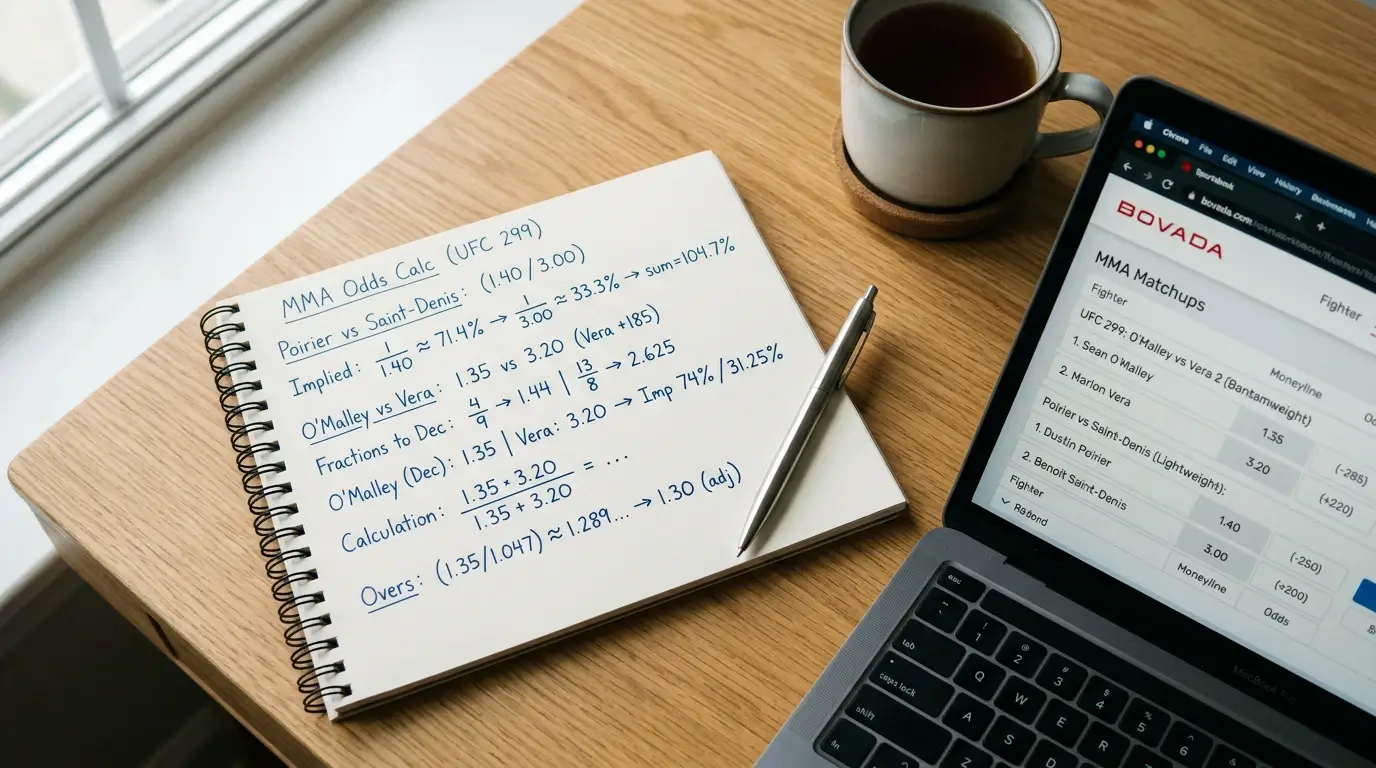
Decimal shines when you're building accumulators. Multiplying 1.57 x 2.10 x 3.50 is far quicker than wrestling with 4/7, 11/10 and 5/2 in fractional form. Most UK sportsbooks let you switch between formats in your account settings — I'd recommend keeping decimal as your default and switching to fractional only when you want the traditional feel.
American Odds
You'll encounter American odds on US-facing sites and in most pre-fight analysis from American MMA media. They use a plus/minus system anchored to $100. A favourite might be listed at -175, meaning you'd need to stake $175 to win $100. An underdog at +200 means a $100 stake returns $200 profit.
For UK purposes, the quickest mental conversion is: a negative American number divided by 100 gives you the fractional denominator over 1 (roughly), and a positive number divided by 100 gives you the fractional numerator over 1. But honestly, unless you're regularly consuming American content, you don't need to memorise this — just toggle your sportsbook to the format you're comfortable with.
Converting Between Formats
Start with American odds of -175 (favourite).
Fractional: 100/175, simplified to 4/7.
Decimal: (4/7) + 1 = 1.571.
All three — -175, 4/7, 1.571 — describe the same probability and the same payout.
Implied Probability
Implied probability — the percentage chance of an outcome that the odds represent, before the bookmaker's margin is applied. It's calculated as: Denominator / (Numerator + Denominator) for fractional odds, or 1 / Decimal odds.
Implied probability is where odds stop being just a payout calculator and start being an analytical tool. If a fighter is priced at 4/7 (1.57 decimal), the implied probability is 63.6%. Your job as a bettor is to decide whether the fighter's real chance of winning is higher or lower than 63.6%. If you consistently find spots where your assessed probability exceeds the implied probability, you're betting with an edge. For a deeper breakdown of implied probability calculations and how to spot value, the dedicated guide walks through it fight by fight.
Types of UFC Bets: From Moneyline to Method of Victory
Here's a number that should shape every bet type you consider: in 2024, 45% of UFC bouts ended by knockout or TKO, 25% by submission, and only 30% went to the judges' scorecards. That split means nearly half of all UFC fights are decided by someone getting hit hard enough to stop the contest. If you're only placing moneyline bets — picking a winner without caring how they win — you're leaving a significant portion of the market's information on the table.
UFC sportsbooks in the UK typically offer six core bet types. Each serves a different analytical angle, and the best approach depends on what you know about the fighters involved.
Moneyline — the simplest UFC bet. You pick which fighter wins. No need to predict the method or the round, just the winner. This is where most beginners start, and it's perfectly valid for bouts where you have a strong directional view but limited insight into how the fight will end.
Method of Victory — you predict not only who wins but how: by KO/TKO, submission, or decision. Payouts are higher because you're narrowing the outcome. This market rewards bettors who study finish rates and stylistic matchups.
Round Betting — you predict the specific round in which the fight ends, or the specific round a named fighter wins. The odds here can be substantial because you're pinpointing timing, which is inherently difficult. Round betting suits fights where one fighter has a clear early-finish tendency or a known cardio dropoff.
Over/Under Rounds — the sportsbook sets a total (usually 1.5 or 2.5 rounds for a three-round fight, or 2.5 or 3.5 for a five-round championship bout), and you bet on whether the fight lasts longer or shorter. This is a pure durability play — it doesn't matter who wins, only how long the fight goes.
Props — proposition bets cover almost anything outside the main outcome: will the fight go the distance, will there be a knockdown in round one, will either fighter attempt a takedown. Props range from straightforward to exotic, and they're where deep fight knowledge creates the biggest edges.
Futures / Outrights — long-range bets on outcomes like "who will be the next lightweight champion" or "who will win Fight of the Year." These markets are less liquid and less efficient, which can mean better value for patient bettors who follow roster movements and rankings closely.
Moneyline in Practice
Suppose Fighter A is priced at 4/9 (1.44 decimal) and Fighter B at 7/4 (2.75 decimal). The market is saying Fighter A wins roughly 69% of the time. If your own analysis puts Fighter A's win probability at 75%, the moneyline on the favourite offers value. If you think the fight is closer to 60/40, the underdog is the play.
The finish-rate split I mentioned earlier — 45% KO, 25% submission, 30% decision — isn't uniform across the card. Heavyweight bouts finish by KO at rates above 60%, while lighter women's divisions regularly go the distance. That variation is exactly why understanding each bet type and when to deploy it matters more in UFC than in almost any other sport. A moneyline bet on a heavyweight card and a moneyline bet on a women's strawweight card carry completely different risk profiles, even if the odds look similar.
Fighter Analysis: The Stats That Actually Move UFC Odds
Last year I backed a +180 underdog in a middleweight bout purely because the favourite's takedown defence sat at 54% and the underdog was averaging 4.2 takedown attempts per fifteen minutes. The favourite had flashier knockouts on his highlight reel, more Instagram followers, more hype in the pre-fight press conference. None of that showed up in the data. The underdog wrestled his way to a unanimous decision, and the odds never reflected how predictable that outcome was if you'd looked at the right numbers.
Favourites won 72% of UFC bouts in 2024. That's a useful baseline, but it masks enormous variation across weight classes, matchup styles and fight contexts. The stats that actually move odds — and that you should be tracking — fall into a handful of categories that most casual bettors ignore entirely.
Five Stats to Check Before Every UFC Bet
- Reach and stance — a significant reach advantage combined with an orthodox-vs-southpaw matchup can reshape striking exchanges
- Significant strike accuracy — fighters landing above 50% tend to control distance and score rounds consistently
- Takedown defence percentage — anything below 65% against a wrestler is a red flag for stand-up fighters
- Cardio history — check how the fighter's output changes between round one and round three (or four and five in title fights)
- Camp and coaching changes — a recent switch in training camp often signals a strategic shift that the odds haven't priced in
Divisional patterns tell you as much as individual fighter stats. In the heavyweight division, 62% of bouts end by knockout or TKO — the highest rate on the roster. Betting the over/under on a heavyweight fight requires a completely different framework than doing the same in women's bantamweight, where bouts went past the 1.5-round mark 96% of the time across recent years. If you're placing identical bet types across divisions without adjusting for these base rates, you're ignoring free information.
62%
Knockout rate in the heavyweight division
96%
Women's bantamweight bouts lasting beyond 1.5 rounds
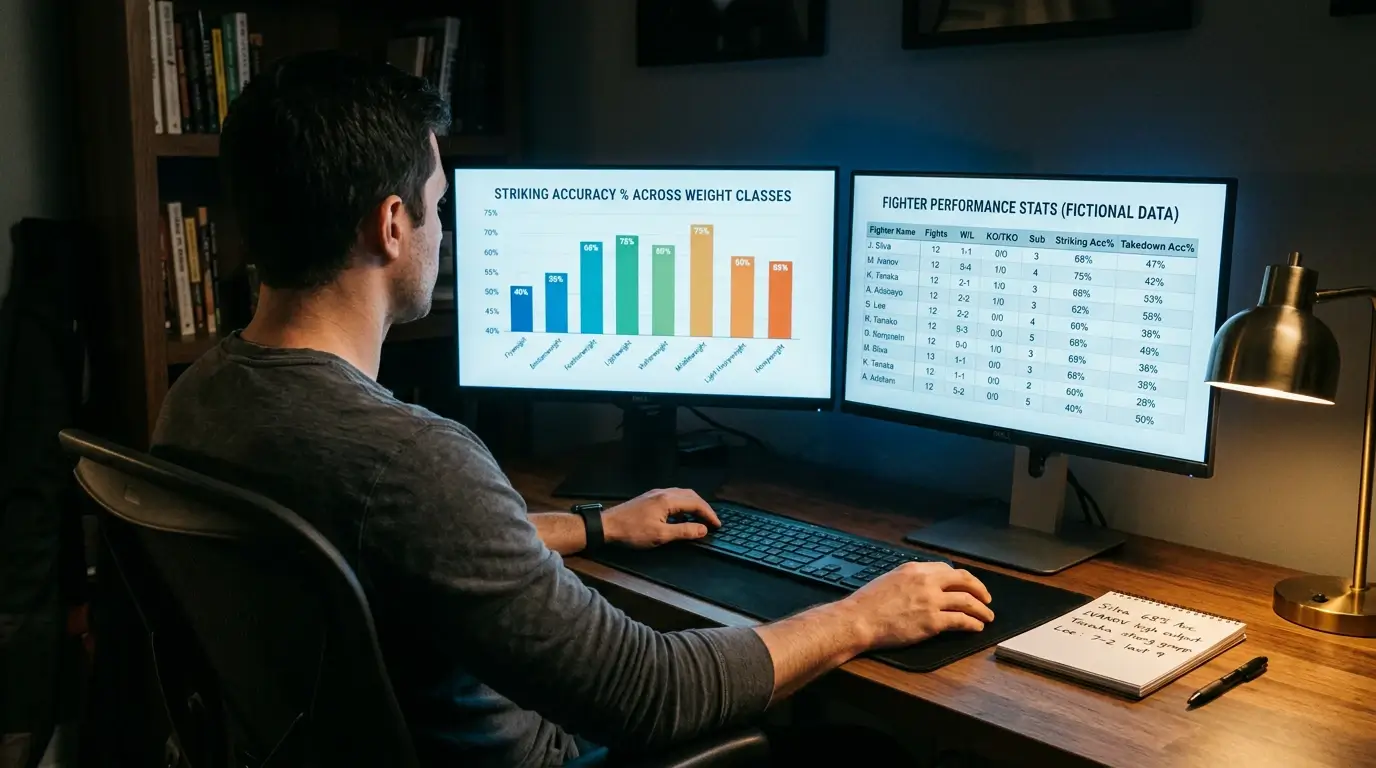
Two patterns consistently catch casual bettors off guard. First, rematches: the winner of the first fight wins again 66% of the time, with an overall record of 52-26 in repeat matchups. That's a strong enough trend to factor into your handicapping whenever a rematch headline surfaces. Second, champions who enter a title defence as the betting underdog still defend successfully 63% of the time — 12 wins out of 19. The market systematically undervalues the champion's cage experience and mental edge in those situations.
None of these numbers guarantee outcomes. What they do is give you a statistical anchor that most of the betting public doesn't have. When the odds imply a 40% chance for a champion-underdog and the base rate says 63%, that's a discrepancy worth investigating further. For a detailed walkthrough of how to build fighter profiles and apply these metrics card by card, the UFC betting strategy guide goes deeper into the process.
Live UFC Betting: In-Play Markets and Momentum Reads
The first time I placed a live UFC bet, I nearly missed the window. I'd watched a favourite get clipped in round one, saw his legs wobble, and by the time I'd navigated to the in-play market on my phone, the odds had already swung three points. That speed is what separates live UFC betting from pre-fight markets — and it's also what makes it dangerous if you don't have a plan before the first bell rings.
UFC events generate 11% of all live-betting clicks on major platforms during fight nights. That's a remarkable share for a sport with far fewer events per year than football or tennis, and it tells you that in-play UFC markets attract serious volume. The liquidity is there. The question is whether you can process what you're watching fast enough to exploit it.
Live UFC odds move in seconds, not minutes. Unlike football, where a goal changes the market in a predictable way, a single landed punch in MMA can trigger a dramatic odds swing. If you're planning to bet in-play, identify your triggers before the fight starts: which fighter do you back if they lose round one? At what price does the underdog become value? Having pre-set thresholds stops you from chasing emotion in real time.
What to watch between rounds: corner audio (when broadcast), body language during the break, visible damage, and breathing rate. A fighter who sits down heavily on the stool and takes deep breaths after a round he supposedly won is showing signs of cardio strain that the scorecards won't reflect until the later rounds. These visual cues don't appear in any stat sheet, but they move the fight's probability in ways the in-play algorithm might lag behind.
Momentum shifts are the bread and butter of live UFC value. A fighter who gets taken down twice in round one but stuffs the next four attempts has likely solved the puzzle. If the in-play odds still reflect the early takedown success rather than the defensive adjustment, that's a window. It closes fast, but it opens more often than you'd expect, especially on undercards where the live-pricing models have less historical data to work with.
Do
- Set price thresholds before the fight begins
- Watch corner activity and body language during breaks
- Focus on undercards where live models are less refined
- Bet on adjustments you can see — stance switches, defensive corrections
Don't
- Chase a bet after a dramatic knockdown — the odds have already moved
- Assume round one dictates the rest of the fight
- Place live bets on your phone while also watching on a delayed stream
- Ignore the time delay between broadcast and sportsbook feed

Live betting rewards preparation and punishes reaction. The punters who do well in-play are the ones who've already studied the matchup, identified the pivots that could shift the fight, and decided their entry points in advance. For a deeper look at in-play strategies, round-by-round reading and cash-out timing, the live UFC betting guide breaks it all down.
Why UFC Odds Move: Sharp Money, Line Shifts and Weigh-In Signals
A UFC main event opened with the favourite at -250. By the time I checked the line again, forty-eight hours before the weigh-in, it had drifted to -130. That kind of swing doesn't happen because a few recreational punters changed their minds. It happens because informed money — what the industry calls sharp money — has moved into the market with enough volume to shift the price.
Sharp money refers to wagers placed by professional or highly informed bettors whose action sportsbooks respect enough to move the line. When sharps back one side of a UFC fight, the bookmaker adjusts the odds not just to balance liability but because sharp action often signals genuine information — an injury, a poor weight cut, a camp leak — that the wider market hasn't absorbed yet.
Lines move for three primary reasons. The first is volume: enough money on one side forces the sportsbook to adjust. The second is news: a confirmed injury, a last-minute opponent switch, or footage from open workouts showing a fighter who looks sluggish or sharp. The third — and the one most bettors underestimate — is the weigh-in window. In the final 48 hours before official weigh-ins, underdogs transition into favourites in 23% of main events. That's nearly one in four headline bouts where the market completely reverses its initial assessment.
23% of UFC main events see the underdog flip to favourite status in the 48 hours before the weigh-in — driven by late-breaking camp intel, weight-cut concerns and sharp-money flows.
Why does the weigh-in window matter so much? Because that's when the most reliable information enters the market. A fighter who struggles to make weight often looks visibly drained at the weigh-in, and experienced bettors know that a tough weight cut can reduce chin durability, cardio and power output. Camp insiders sometimes share information about sparring injuries or strategic changes that only surface in the final days. The pre-weigh-in period is, in effect, the last data dump before the fight, and the odds respond accordingly.
Not every line shift is legitimate. In November 2025, the odds on a fight featuring Dulgarian shifted from -250 to -130 within hours before the bout — the largest anomalous swing flagged by IC360, the UFC's independent betting integrity monitor. Multiple major sportsbooks voided all wagers on that fight, a step typically reserved for serious integrity concerns. That case is a reminder that while most line movement reflects genuine information flow, extreme or sudden shifts can signal something else entirely. Tracking how and when odds move — not just where they settle — is one of the most underused analytical tools available to UK bettors.
My own approach is to record the opening line for every fight I'm considering and then check twice: once midweek, once after the weigh-in. If the line has moved against my position by more than 15%, I reassess my analysis before placing anything. If it's moved in my favour, I ask why — and whether the reason is already priced in. Line movement isn't a betting strategy on its own, but it's the single best barometer of where the smart money sits.
OCTAPICKS proprietary tool
The Steam Gauge: line-movement audit
Enter the opening and current prices for both fighters in any format — 4/7, 1.57 or -175. The gauge strips the bookmaker's margin out of both snapshots, separates genuine information from margin widening, and tests whether the price you took still beats the market.
Fighters
Opening line
Current line
Your position (optional)
Sharp move · 6.3 points
Fighter A has shed 6.3 points of de-vigged win probability since the open. A move of this size is usually information entering the market, not routine trading.
Favourite flip detected — this happens in 23% of main events inside the weigh-in window
Your 1.65 is 9.0% behind the fair price of 1.81. The market has repriced this fighter against you since you placed the bet — no reason to add to the position.
Method: both snapshots are de-vigged proportionally across the two-way market, so the opening and current probabilities are directly comparable. Bands: under 2 points is market noise, 2–6 points routine drift, 6–12 points a move with information behind it, 12 points or more an extreme shift worth verifying against news before you bet. For reference, the November 2025 bout flagged by IC360 moved roughly 15 points. Informational tool only, 18+.
UFC Betting in the UK: Regulation, Platforms and the NetBet Partnership
I get asked regularly whether betting on UFC is actually legal in the UK. The answer is yes, unambiguously — provided you're using a platform licensed by the UK Gambling Commission. That licence isn't a rubber stamp. It means the operator has met capital adequacy requirements, implemented responsible gambling tools, submitted to regular audits and agreed to segregate customer funds. For you as a bettor, a UKGC licence is the minimum standard. Anything less, and you're operating outside the regulatory framework that exists specifically to protect your money and your data.
What UKGC Licensing Means for You
A UK Gambling Commission licence guarantees that the operator holds customer funds separately from operational accounts, offers mandatory self-exclusion tools, provides transparent terms on bonuses and withdrawals, and submits to dispute resolution through an independent adjudicator. If a licensed operator fails to pay out a legitimate winning bet, you have a regulatory body with real enforcement power standing behind you.
The scale of the UK gambling market provides important context. The remote casino, betting and bingo sector generated gross gambling yield of £7.8 billion between April 2024 and March 2025 — a 13.1% year-on-year increase. Average monthly active online accounts reached 13.5 million in the most recent quarter, and 10% of British adults reported placing a bet in the preceding four weeks, with a notable gender split: 16% of men and 4% of women. These figures mean that when you place a UFC bet through a UKGC-licensed platform, you're participating in one of the most heavily regulated and actively monitored gambling markets in the world.
£7.8B
UK remote gambling gross gambling yield, April 2024 to March 2025
13.5M
Average monthly active online betting accounts in the UK
10%
Share of British adults who reported betting in the last four weeks
The UFC has also been building its own infrastructure within the UK market. In March 2025, NetBet became the official betting partner of UFC across the UK, Ireland, Greece, Italy and Romania. NetBet's CEO, Marcel Prioteasa, described the partnership as uniting "the adrenaline-pumping action of the world's premier mixed martial arts organisation with the elite betting experience our customers expect." From the UFC side, Nicholas Smith, SVP and Head of International Business at TKO, highlighted the organisation's growth trajectory across Europe and the value of partnering with an operator that already had an established UFC fan base.
What should you look for when choosing a platform? Beyond the UKGC licence — which is non-negotiable — the factors that matter most for UFC betting are market depth (does the platform offer method of victory, round betting and props for undercard fights, not just main events?), odds competitiveness (compare the same fight across three platforms before you commit to one), live-betting functionality (speed and reliability of the in-play interface during broadcasts), and cash-out availability on UFC markets. For a detailed comparison of what different UFC betting platforms offer UK punters, the dedicated guide covers the selection criteria that actually matter.
Betting Integrity: How the UFC Polices Its Odds
No one wants to think about match-fixing when they're placing a bet. I certainly didn't — until the Dulgarian situation in late 2025 forced every serious UFC bettor to confront the question directly. Three major sportsbooks refunded all wagers on that fight, a measure that doesn't happen over a routine line movement. It happens when the integrity alarm bells are loud enough that operators decide the safest course is to void the market entirely.
IC360 monitors betting activity on every UFC bout. The independent integrity service tracks wagering patterns in real time, flagging anomalous line shifts and coordinating with sportsbooks and regulators. Dana White has stated publicly that IC360 watches "every fight that happens in the UFC, from the first prelim to the main event" and called them "the best in the business."
The UFC's public stance on integrity has been aggressive. White has warned potential bad actors that the organisation will do everything in its power to ensure they face criminal prosecution. Mark Shapiro, TKO's President and COO, has framed the issue in terms of scale: the organisation is aware of investigations into only two isolated incidents over the span of three years, against a backdrop of nearly 500 fights per year. That ratio matters for perspective, but it doesn't eliminate the structural vulnerabilities.
Fighter Pay as a Structural Risk Factor
UFC fighters receive approximately 16-20% of the organisation's revenue, compared to the 50% revenue share that athletes in the NBA, NFL and NHL typically receive. That gap creates a financial environment where lower-ranked fighters — many of whom earn five-figure purses for bouts that generate six- or seven-figure betting handles — face disproportionate economic pressure. N. Jeremi Duru, a professor of sports law at American University, has argued that the possibility of predetermined outcomes in sport represents an existential threat: if serious doubt is sown about true competition, it ceases to be sport at all.
Sportradar's integrity services division reported a 103% year-on-year revenue increase in Q3 2025, reaching $4.2 million for the quarter alone. That growth reflects how seriously the broader sports industry — not just UFC — is investing in monitoring infrastructure. For bettors, the practical takeaway is this: integrity frameworks exist, they're more sophisticated than they were even two years ago, and the UFC has financial incentives to maintain them because the $7.7 billion Paramount deal and the $350 million DraftKings partnership both depend on the sport's credibility.
Does that mean you should worry about every bet you place? No. It means you should treat sudden, unexplained line movements — particularly in lower-profile bouts with less media attention — as a data point, not an invitation. If a line shifts dramatically and you can't find a public explanation (injury report, weight-cut news, camp change), stepping away from that fight is a legitimate analytical decision, not paranoia.
Bankroll Management for UFC Punters
I blew through my first UFC bankroll in six weeks. Not because my picks were terrible — I was hitting at around 55% — but because I had no system for sizing my bets. I'd put £50 on a fight I loved and £5 on one I was lukewarm about, with no logic connecting the two decisions. The emotional highs and lows were fun until the bankroll hit zero and I had to reload. That reload was the price of a lesson most bettors learn too late: edge without discipline is just entertainment with extra steps.
UFC demands stricter bankroll management than most sports for one simple reason — volume. The Premier League gives you 380 matches per season. The UFC runs roughly 43 events per year, with 10 to 14 bouts per card. That's around 500 fights total, which sounds like a lot until you narrow it to the fights where you have a genuine analytical edge. For me, that's typically four to eight bets per event on the cards I cover closely, and zero on the ones I haven't studied.
The system I use — and the one I'd recommend to anyone starting out — is flat staking with a fixed unit size of 2% of your total bankroll.
Flat Staking in Practice
Starting bankroll: £500.
Unit size: 2% = £10 per bet.
Bet 1: Fighter A moneyline at 6/5 (2.20 decimal). Stake: £10. Win: +£12 profit. Bankroll: £522.
Bet 2: Fighter B method of victory (KO/TKO) at 11/4 (3.75 decimal). Stake: £10. Loss: -£10. Bankroll: £512.
Bet 3: Over 2.5 rounds at 4/5 (1.80 decimal). Stake: £10. Win: +£8 profit. Bankroll: £520.
After three bets: bankroll £520 (+4%). Two winners out of three, with the unit size protecting the downside on the loss.

Why 2% and not 5% or 10%? Because UFC variance is high. A single underdog knockout can erase a string of correct favourites, and fight cancellations or no-contests are more common than in team sports. At 2% per unit, you can absorb a ten-bet losing streak — which will happen eventually, no matter how good your analysis is — and still retain 80% of your bankroll. At 5%, that same streak costs you half.
Some experienced bettors use proportional staking or the Kelly criterion, which adjusts bet size based on perceived edge. These approaches can be more profitable in theory, but they require you to estimate your edge accurately on every single bet — and most people overestimate their edge most of the time. Flat staking is less glamorous and less theoretically optimal, but it's robust against the two things that actually destroy bankrolls: variance and overconfidence.
Do
- Set a fixed unit size and stick to it across every bet
- Track every wager in a spreadsheet — stake, odds, result, running bankroll
- Review your record after every 50 bets to identify patterns
- Take a full card off if you've hit three or more consecutive losing events
Don't
- Double your stake to "chase" a loss from the previous fight
- Size bets based on how confident you "feel" rather than a system
- Bet on every fight on every card — selectivity is bankroll protection
- Count bonus money or promotional credits as part of your working bankroll
Frequently Asked Questions About UFC Betting Odds
How do UFC betting odds work in the UK?
UFC betting odds in the UK are typically displayed in fractional format by default, though most sportsbooks allow you to switch to decimal. Fractional odds like 4/7 tell you the profit relative to your stake — a £7 bet at 4/7 returns £4 profit plus your £7 stake. Decimal odds like 1.57 show your total return per £1 staked, including the original stake. Both formats express the same underlying probability. The odds reflect the bookmaker's assessment of each fighter's chance of winning, adjusted for the operator's margin. Your edge as a bettor comes from identifying fights where the real probability differs from what the odds imply.
What types of bets can I place on UFC fights?
UK sportsbooks offer several UFC bet types. The moneyline is the simplest — pick the winner. Method of victory adds a layer by requiring you to predict whether the winner will succeed by KO/TKO, submission or decision. Round betting lets you pinpoint when the fight ends. Over/under rounds sets a total (usually 1.5 or 2.5) and you bet on whether the fight lasts longer or shorter. Prop bets cover specific in-fight events like knockdowns or takedowns. Futures and outrights let you bet on longer-term outcomes such as who will hold a title at a specific date. Each type suits different levels of analysis and different kinds of matchups.
What is the best UFC betting site in the UK?
There is no single "best" site — the right platform depends on what you prioritise. The non-negotiable baseline is a UK Gambling Commission licence, which ensures regulatory oversight, fund segregation and dispute resolution. Beyond that, compare market depth (does the platform offer method of victory and round betting for undercard fights, not just main events?), odds competitiveness across a handful of recent cards, live-betting speed during broadcasts, and cash-out availability on UFC markets. NetBet holds the status of official UFC betting partner in the UK as of March 2025, though partnership status alone shouldn't dictate your choice — value and market depth matter more.
How do I read fractional odds for UFC?
Fractional odds are written as two numbers separated by a slash. The formula for calculating your profit is: Profit = Stake x (Numerator / Denominator). For example, if a fighter is priced at 5/2 and you bet £10, your profit is £10 x (5 / 2) = £25, with a total return of £35 including your stake. When the first number is smaller than the second (e.g. 4/7), the fighter is the favourite — you risk more than you stand to gain. When the first number is larger (e.g. 5/2), the fighter is the underdog. To convert fractional odds to implied probability, divide the denominator by the sum of both numbers: for 5/2, that's 2 / (5 + 2) = 28.6%.
Can I bet on UFC fights live (in-play)?
Yes, most UK-licensed sportsbooks offer live in-play betting on UFC events. In-play markets typically include updated moneyline odds, method of victory, and round betting, all adjusting in real time as the fight progresses. UFC events generate 11% of all live-betting clicks on major platforms during fight nights, so the liquidity in live markets is meaningful. The key challenge is speed — UFC odds can shift dramatically after a single significant strike or takedown, so having pre-set price thresholds and a fast, stable connection is essential. Many experienced in-play bettors plan their entries before the fight begins and only act when specific conditions are met.
What is a UFC prop bet and how does it work?
A proposition bet — or prop bet — covers a specific event within a fight rather than the overall outcome. Common UFC props include whether the fight will go the distance, whether either fighter will score a knockdown, whether there will be a submission attempt, and which round the fight will end. Props are priced individually, and because they require detailed knowledge of fighter tendencies and matchup dynamics, they tend to offer sharper edges for well-informed bettors. For example, if a fighter has attempted at least one takedown in 90% of his bouts, a prop betting on a takedown attempt at even money represents clear value based on historical tendency.
Is UFC betting legal in the UK?
UFC betting is fully legal in the United Kingdom for anyone aged 18 or over, provided you use a platform licensed by the UK Gambling Commission. The UKGC regulates all forms of sports betting, including MMA, and licensed operators must comply with strict requirements around customer fund protection, responsible gambling tools, fair terms and independent dispute resolution. The UK gambling market generated £7.8 billion in gross gambling yield for remote betting and gaming in the year ending March 2025, and UFC is among the sports covered by every major licensed operator. There is no separate regulation for combat sports betting — it falls under the same licensing framework as football, tennis or horse racing.
Related posts
UK UFC Audience Demographics and Betting Market Growth

UFC Betting Record Keeping and ROI Tracking