Complete UFC and MMA Betting Glossary
 Available in US
I have split the terms into two groups: fight and scoring terminology, and betting and odds terminology. Each definition is written the way I wish someone had explained it to me when I was starting out — plain language, practical context, and a clear link to how the term affects your bets.
MMA Fighting and Scoring Definitions: A Comprehensive Glossary
A friend once asked me the difference between a KO and a TKO in the middle of a live event. I started explaining and he missed the next fight entirely. Here is the short version — and everything else you need to know about how fights end.
Knockout (KO): A fighter is rendered unconscious by a strike — typically a punch, kick, knee, or elbow. The fight is over immediately. KOs are the most definitive ending in MMA and have a direct impact on method of victory markets. In 2024, 45% of UFC bouts ended by KO or TKO combined.
Technical Knockout (TKO): The referee stops the fight because a fighter is absorbing damage without intelligently defending themselves, even though they have not been fully knocked unconscious. Doctor stoppages and corner stoppages are also classified as TKOs. Most bookmakers group KO and TKO together in their method of victory markets — if you bet “KO/TKO,” both outcomes pay.
Submission: A fighter forces their opponent to tap out by applying a joint lock or choke. Common submissions include the rear-naked choke, guillotine choke, armbar, and triangle choke. Submissions accounted for approximately 25% of UFC finishes in 2024. Grapplers and Brazilian jiu-jitsu specialists are the most likely to win by this method.
Decision (Unanimous, Split, Majority): If the fight goes the full distance — three rounds for a standard bout, five rounds for a main event or title fight — the judges’ scorecards determine the winner. A unanimous decision means all three judges agree. A split decision means two judges favour one fighter and one favours the other. A majority decision means two judges favour one fighter and one scores it a draw. Roughly 30% of UFC bouts in 2024 went to decision.
10-Point Must System: The scoring system used by UFC judges. The winner of each round receives 10 points and the loser receives 9 or fewer. A dominant round is scored 10–8, an extremely dominant round 10–7. Understanding this system helps when betting round-by-round props or predicting scorecards.
Significant Strikes: Strikes that land at distance or in the clinch, as distinguished from ground-and-pound strikes that land without much force. UFCStats tracks significant strikes per minute (SLpM) and significant strike accuracy as two of the most cited fighter metrics.
Takedown: A transition from standing to the ground where the attacking fighter establishes control. Takedown average (per 15 minutes) and takedown defence percentage are critical stats for predicting whether a fight stays on the feet or goes to the mat.
Control Time: The amount of time a fighter spends in a dominant position on the ground. Judges weigh control time when scoring rounds, particularly in fights where significant strikes are low. Heavyweight knockouts happen at a rate of 62%, but in the women’s strawweight division, 68% of bouts go to decision — making control time far more relevant in lighter weight classes.
No Contest: A fight is declared null, typically due to an accidental foul (headbutt, eye poke) before the halfway point. No winner is declared. Most bookmakers void all bets on a No Contest result.
Betting and Odds Terms
The fight terms tell you what happened. The betting terms tell you what it is worth. If you can speak both languages, you have an advantage over the vast majority of punters who only understand one.
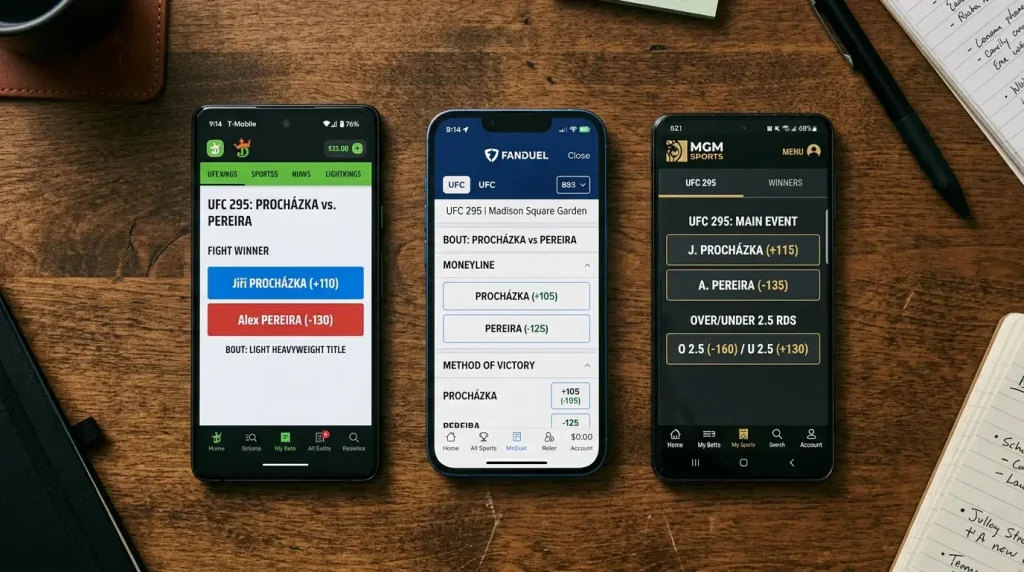
Moneyline: The simplest UFC bet — pick the winner. Odds are expressed in decimal form in the UK (e.g. 1.50 for a favourite, 3.00 for an underdog). A moneyline bet requires no further conditions — if your fighter wins by any method, you cash.
Over/Under (Total Rounds): A bet on whether the fight will last more or fewer rounds than a specified line, typically 1.5 or 2.5 for a three-round fight and 2.5, 3.5, or 4.5 for a five-rounder. Understanding finish rates by division is essential for this market. For a deeper look at how these work, see UFC odds explained.
Prop Bet (Proposition Bet): Any bet beyond the moneyline and over/under. Common UFC props include method of victory (KO/TKO, submission, decision), exact round finish, fight to go the distance (yes/no), and fighter performance props like total significant strikes landed.
Parlay / Accumulator (Acca): A single bet that combines multiple selections. All legs must win for the bet to pay. Accas offer higher potential payouts but carry substantially higher risk, because one wrong leg collapses the entire slip.
Implied Probability: The probability of an outcome as suggested by the odds. Decimal odds of 2.00 imply a 50% chance. Decimal odds of 1.25 imply an 80% chance. Comparing implied probability to your own estimated probability is the foundation of finding value.
Vig / Juice: The bookmaker’s margin built into the odds. If a true 50/50 fight were priced at 2.00 on both sides, there would be zero vig. In reality, the book prices both sides at around 1.90, keeping the difference as profit. Lower vig means better value for bettors.
Value: A bet has value when the odds offered imply a lower probability than your own assessment. If you believe a fighter has a 40% chance of winning and the odds imply only 30%, that is a value bet — even though the fighter is more likely to lose than win.
Sharp / Square: “Sharp” refers to professional or highly informed bettors whose wagers move lines. “Square” refers to recreational bettors whose money the bookmakers are happy to absorb. Most UFC betting volume is square money, which is why line movement late in fight week often reflects sharp correction rather than genuine changes in fighter form.
Line Movement: A change in the odds between opening and closing. Significant line movement usually indicates sharp money or breaking news (injuries, weight-cut issues). Tracking line movement is a skill that separates casual punters from serious bettors.
Glossary Questions
Two questions new bettors ask more than any others when they first encounter MMA terminology.
What is the difference between a KO and a TKO in UFC?
A KO (knockout) means the fighter was rendered unconscious by a strike. A TKO (technical knockout) means the referee, doctor, or corner stopped the fight because the fighter was taking damage without intelligently defending — even though they were still conscious. For betting purposes, most bookmakers group both outcomes together as KO/TKO in method of victory markets.
What does sharp money mean in UFC betting?
Sharp money refers to bets placed by professional or highly informed bettors who have a proven track record. When sharp money enters a UFC market, the line typically moves because bookmakers respect those bettors’ analysis. Tracking line movement caused by sharp money can help you identify which side the informed market favours, even if you have not done your own analysis on that particular fight.
This material was created by the OCTAPICKS team.
Related posts

UK UFC Audience Demographics and Betting Market Growth

UFC Betting Record Keeping and ROI Tracking