
UFC Betting Strategy and Statistical Methods
 Available in US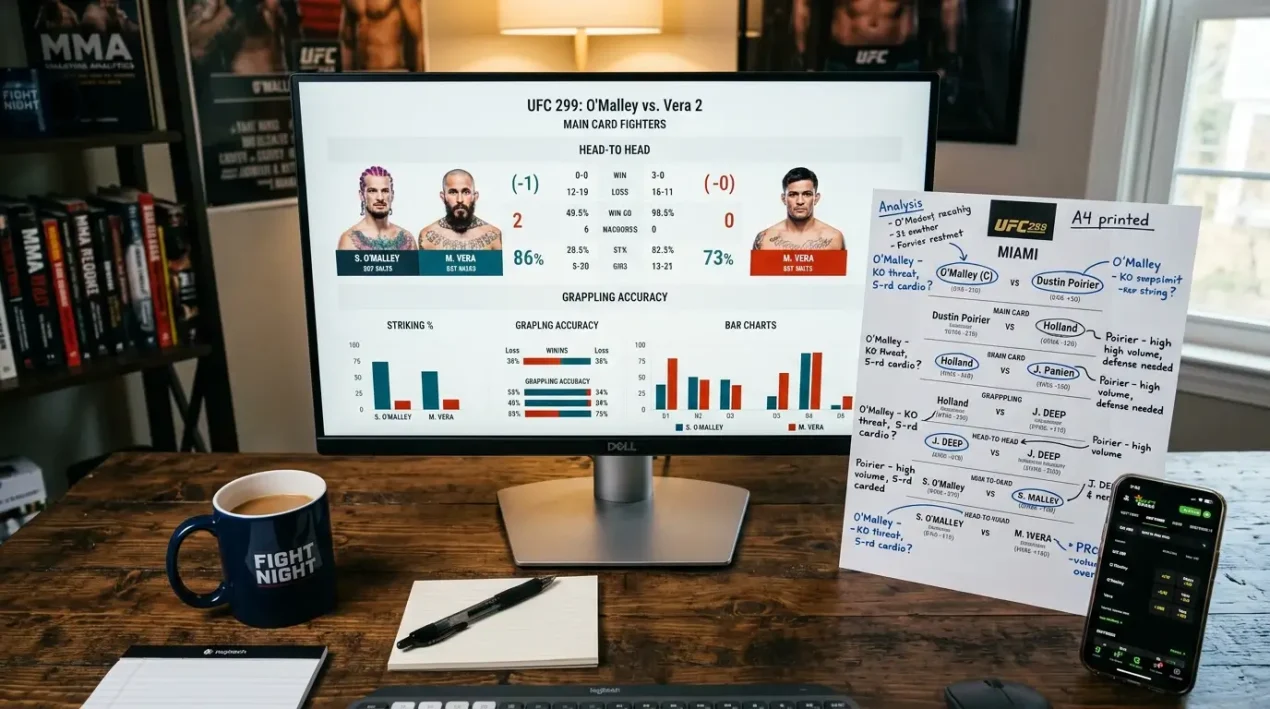
What follows is the system I’ve refined over six years of analysing UFC cards. It’s built on fighter profiling, divisional patterns, underdog identification, line timing, and disciplined staking. None of it is complicated. All of it requires discipline.
Even the sharpest analytical models will fail without proper UFC bankroll management strategies to sustain you through losing streaks.
Fighter Profiling Statistics: Metrics That Predict UFC Fight Outcomes
Three years ago, I started logging which statistics actually correlated with my winning bets versus my losers. The result surprised me: the flashy numbers — knockout highlight reels, finishing rate, record — were poor predictors. The boring numbers — strikes absorbed per minute, takedown defence percentage, control time differential — were far more reliable.
Start with significant strikes landed per minute versus significant strikes absorbed per minute. This ratio — offensive output against defensive cost — tells you whether a fighter creates more damage than he receives. A fighter landing 5.2 significant strikes per minute while absorbing 2.1 is in a fundamentally different position than one landing 4.8 but absorbing 4.6. The second fighter is in a coin-flip exchange every round. The first is winning the attrition battle. When both fighters in a matchup have favourable ratios, the fight is more likely to go the distance. When one has a massively unfavourable ratio, a finish becomes more probable.
Takedown defence percentage is the single most underrated metric in UFC betting. A striker with 85% takedown defence can keep the fight standing where his skills dominate. The same striker with 55% takedown defence is vulnerable to any competent wrestler, regardless of how good his hands are. I check this number before anything else when analysing a matchup between a striker and a grappler. If the striker’s defence is above 80%, the grappler needs an elite offensive wrestling pedigree to implement his game plan. Below 65%, and the grappler’s path to victory opens considerably.
Rematches offer a unique statistical lens. The fighter who won the first bout wins the rematch 66% of the time — a 52-26 overall record. That number is high enough to be actionable but not so high that the market always accounts for it. When a rematch is announced, check whether the closing line reflects a 66% probability for the first-bout winner. If the price implies less than that, you’ve found a potential edge. Rematches also carry qualitative nuance: has the losing fighter changed camps, addressed a specific weakness, moved up or down a weight class? The 66% baseline adjusts based on what’s changed between fights.
Building a profile means assembling these metrics — striking differential, takedown defence, submission attempts per 15 minutes, control time, finishing rate — and comparing them against the opponent’s corresponding numbers. Where one fighter’s strength meets the other’s weakness, that intersection points toward the most probable outcome path. A strong wrestler facing a striker with poor takedown defence and limited submission threat off his back? That intersection suggests a decision win via control time, and the method of victory and over/under markets should reflect that analysis.
One more layer: context-adjusted stats. A fighter’s takedown defence percentage against top-10 opponents may differ drastically from their overall number. A heavyweight’s striking absorption rate in five-round fights tells you something about his cardio that his three-round stats don’t. Raw numbers are the starting point; filtering them by opponent quality and fight context is where the profile becomes genuinely predictive.
Weight Class Patterns: Why Division Matters More Than You Think
I spent my first year betting UFC fights as though every weight class operated the same way. A knockout in heavyweight felt equivalent to a knockout in flyweight. A submission at welterweight seemed interchangeable with one at lightweight. Then I ran the numbers, and the assumption collapsed.
Heavyweights finish by KO/TKO 62% of the time. That’s not a marginal trend — it’s a defining characteristic of the division. The fighters carry more power relative to their defensive durability, the pace is slower, and a single clean shot can end things regardless of who’s winning the round. Betting the over in heavyweight bouts requires conviction that both fighters can absorb punishment, because the base rate says finishes dominate. Over/under lines in this division are set lower for a reason, and the value usually sits with the under unless you have a specific reason to believe both fighters are defensively exceptional.
At the other extreme, women’s bantamweight bouts have gone past 1.5 rounds 96% of the time since 2020 — 27 out of 28 fights. The one exception was a rare first-round stoppage that stands out precisely because of how unusual it was. Over 1.5 rounds in this division is nearly a certainty, and yet the bookmaker still prices it as though there’s meaningful risk of a first-round finish. That pricing gap exists because the algorithm treats all divisions with similar base assumptions and adjusts incrementally, rather than recognising that women’s bantamweight has its own distinct finishing profile.
The overall UFC finish breakdown — 45% KO/TKO, 25% submission, 30% decision — is a useful top-level number, but it masks enormous variance between divisions. Flyweight decisions run higher than the average. Lightweight submissions punch above their weight. Middleweight knockouts track close to the heavyweight rate. Each division has its own statistical fingerprint, and your bet type should reflect the division’s tendencies, not the UFC-wide average.
What this means practically: don’t apply a one-size-fits-all method of victory bias across divisions. If you’re backing a fighter at heavyweight, consider the KO/TKO method market seriously because the base rate supports it. If you’re betting at women’s flyweight, the over/under market is where the division’s data gives you the clearest advantage. Adapting your market selection to the division’s statistical profile is one of the simplest edges available, and it’s one that most casual bettors ignore because they bet the same way regardless of weight class.
The Underdog Edge: When Long Odds Carry Real Value
The number that changed how I approach UFC betting landed on my screen during a late-night research session in early 2025. Underdogs priced at +200 or longer — fighters the market expected to lose two out of three times — won 39% of their bouts in 2024. The historical average for that price range sits around 28%. That 11-point gap between expectation and reality isn’t noise; it represents a structural inefficiency in how UFC odds are set.
Not all underdogs are created equal, and the 39% figure includes a disproportionate contribution from a specific profile: the champion-underdog. When a reigning champion enters a bout as the betting underdog, they defend their title 63% of the time. The market treats them as underdogs because the challenger might be on a flashier winning streak, or the public narrative favours the younger fighter. But champions hold that belt for reasons the moneyline sometimes undervalues — experience under pressure, five-round cardio, the ability to make adjustments between rounds. Twelve out of nineteen champion-underdogs won their fights. That’s a record any value bettor should pay attention to.
Line movement in the 48 hours before weigh-ins provides another underdog signal. In 23% of main events, the fighter who opens as the underdog becomes the favourite by the time the weigh-in concludes. These shifts are driven by sharp money — informed bettors who’ve identified something the opening line missed. If you see a main event underdog’s price shortening significantly in the final 48 hours, the smart money is likely moving in, and the original underdog designation may have been a mispricing. For a deeper dive into exactly when and why underdog betting delivers value, that’s a topic that deserves its own analysis.
My underdog checklist is simple: has the fighter held a title at any point? Has the opponent had a disrupted camp or a short-notice booking? Is there a stylistic mismatch that the market hasn’t fully priced? Has the line moved toward the underdog in the final 48 hours? If two or more of those boxes are ticked, I take a serious look at the underdog’s moneyline. If three or more are ticked, I’m placing a bet.
Line Shopping and Timing: When to Place Your UFC Bets
A mate of mine once placed a bet on a UFC main event at 6/4 without checking any other platform. The same fighter was available at 7/4 across the road, as it were. That single line difference on a 20-pound bet meant 5 pounds of lost profit. Over a year of betting, those missed margins compound into serious money.
Line shopping — comparing prices across multiple sportsbooks before placing a bet — is the simplest, most reliable way to increase long-term profitability. It requires no analytical skill, no fight knowledge, no statistical model. You just look at three or four platforms and take the best price. The effort is minimal and the return is guaranteed over volume.
Timing adds a second dimension. UFC lines typically open on Monday for Saturday cards, though some platforms post lines earlier for marquee events. Early lines are set with less information and less market pressure. If your analysis is solid, early lines can offer the best value because the bookmaker hasn’t yet absorbed the weight of public money or sharp action. By Thursday, the lines have tightened. By Friday’s weigh-ins, they’ve absorbed the final pieces of information — actual weight, physical appearance, late news — and the prices are at their sharpest.
Dana White himself has spoken about the relationship between legal betting markets and the UFC’s ecosystem, framing a healthy legal sports betting market as a driver of fan engagement, broadcast value, and sponsorships. That ecosystem depends on competitive, well-calibrated odds, and the competition between licensed bookmakers to offer the sharpest lines benefits the bettor directly. More platforms, more competition, better prices.
My workflow: I check opening lines on Monday, flag any fights where I see a 5% or greater discrepancy between platforms, and bookmark those. By Wednesday, I’ve completed my fighter analysis. By Thursday evening, I’ve decided which bets to place and at which platform. I never bet on Friday unless weigh-in results reveal something significant — a missed weight, a visible size disadvantage, a fighter who looks drained. When that happens, lines move fast and the early price disappears within minutes.
Stay updated with the latest statistical breakdowns by visiting our premier MMA betting guide regularly.
Staking Systems: Flat, Proportional and Kelly Criterion
Knowing which fighter to bet on is half the problem. Knowing how much to bet is the other half, and it’s the half that most punters get catastrophically wrong. I’ve watched people with excellent fight analysis blow through their bankroll in a single night because they staked emotionally instead of systematically.
Flat staking is the simplest approach: every bet is the same size, typically 1-3% of your total bankroll. If you’re working with a 500-pound bankroll and you’ve set your unit at 2%, every bet is 10 pounds regardless of how confident you are. The appeal is discipline. You remove the temptation to “go big” on a fight you feel strongly about, which protects you from the inevitable wrong calls. The downside is that you can’t capitalise proportionally on high-conviction bets — your best call gets the same stake as your weakest one.
Proportional staking adjusts your bet size based on your current bankroll. If you start at 500 and win enough to reach 600, your 2% unit grows to 12. If you drop to 400, it shrinks to 8. This system naturally scales with success and limits damage during losing streaks. It’s more dynamic than flat staking but requires recalculating your unit before every bet, which some people find tedious. I find it essential.
The Kelly criterion takes things further. It tells you the mathematically optimal stake size based on two inputs: your estimated probability of winning and the odds offered. The formula: (probability times decimal odds, minus 1) divided by (decimal odds minus 1). If you estimate a fighter’s true win probability at 60% and the decimal odds are 2.10, Kelly says bet (0.60 times 2.10 minus 1) divided by (2.10 minus 1) = 0.26 divided by 1.10 = 23.6% of your bankroll. That’s aggressive — far more than most people are comfortable risking on a single fight.
This is why fractional Kelly exists. Most professional bettors use quarter-Kelly or half-Kelly, reducing the suggested stake to 6% or 12% in the example above. The mathematical growth rate is slower, but the risk of ruin drops dramatically. UFC is high-variance by nature — fewer events than football, smaller sample sizes, more upsets — so full Kelly is reckless in this sport. I use quarter-Kelly for high-conviction bets and flat staking for everything else. The combination gives me upside exposure on my strongest calls while maintaining discipline across the rest of the card.
The OctaPicks Pre-Fight Checklist
Before every card, I run through the same eight questions. It takes about twenty minutes per fight, and it’s the single most valuable habit I’ve built as a bettor. Skipping steps is how you end up placing bets on gut feeling and then rationalising them afterwards.
First: fighter stats. Pull up both fighters’ striking differential, takedown accuracy, takedown defence, and finishing rate. Don’t look at their records — look at their performance metrics against the quality of opposition they’ve faced. A 12-2 record means nothing if ten of those wins came against regional-level competition.
Second: stylistic matchup. How do the fighters’ skill sets interact? Striker versus grappler, pressure fighter versus counter-striker, orthodox versus southpaw. The matchup dictates the most probable fight dynamic, which in turn points toward the most valuable bet type.
Third: recent form. Not just win/loss, but how they won or lost. A fighter coming off two decision losses might have more gas in the tank than one coming off two knockout losses. Cumulative damage matters, and recent performance trajectory tells you whether a fighter is ascending, plateauing, or declining.
Fourth: camp and coaching changes. Has either fighter switched gyms since their last bout? New coaches bring new strategies, and the adjustment period can work for or against a fighter depending on how much time they’ve had to integrate.
Fifth: weight cut history. Fighters who’ve struggled to make weight in past bouts are at risk of a compromised performance. A bad cut affects cardio, chin durability, and mental sharpness. Check whether either fighter has missed weight before or moved up from a lower division recently.
Sixth: venue and context. Title fights and main events go five rounds. Altitude affects cardio. Fight island cards had different dynamics than domestic US cards. These contextual factors rarely change the outcome on their own, but they shift probabilities by a few percentage points — enough to move a bet from value to no-value.
Seventh: line movement. Has the price moved since opening? In which direction? Sharp money or public money? If the line has moved against your intended bet, ask why before proceeding.
Eighth: bankroll allocation. Based on your conviction level and your staking system, how much are you risking? Set the number before the fight starts, write it down, and don’t change it mid-card regardless of how other bets are performing.
How do I use UFCStats.com to analyse fighters before betting?
UFCStats.com provides detailed per-fight metrics for every UFC fighter: significant strikes landed and absorbed per minute, takedown accuracy, takedown defence percentage, submission attempts, and control time. Pull up both fighters in your matchup, compare their key metrics, and focus on where one fighter’s strength meets the other’s weakness. The site updates after each event.
Is the Kelly criterion realistic for casual UFC punters?
Full Kelly is too aggressive for UFC due to the sport’s high variance and small sample sizes. Most experienced bettors use quarter-Kelly or half-Kelly, which reduces the suggested stake to a more manageable level. If you’re not comfortable estimating precise win probabilities, flat staking at 1-3% of your bankroll per bet is a simpler and safer alternative.
Should I bet early or wait until fight week?
Early lines — posted Monday for Saturday cards — can offer value before public money and sharp action move the price. However, waiting until Thursday or Friday gives you more information: training camp reports, weigh-in results, and late injury news. A balanced approach is to flag value on Monday and execute by Thursday, adjusting if weigh-in results reveal something significant.
What is the most profitable UFC weight class to bet on?
No single weight class is universally profitable, but divisions with extreme statistical tendencies offer clearer edges. Heavyweight’s 62% KO/TKO rate makes method of victory and under markets more predictable. Women’s bantamweight’s 96% over 1.5 rounds rate creates near-certain over bets. The key is matching your bet type to the division’s statistical profile rather than applying one approach across all weight classes.
This material was created by the OCTAPICKS team.
Related posts

UK UFC Audience Demographics and Betting Market Growth

UFC Betting Record Keeping and ROI Tracking